
Category: History

Aprilia DiTech — The Direct-Injection Two-Stroke That Nearly Worked

Aprilia DiTech (2000) was an air-assisted direct-injection two-stroke built under licence from Australia's Orbital and fitted to the SR 50 scooter. A crank-driven compressor supplied air at about 5 bar, fuel was metered into an air-fuel rail, and a direct injector fired the mixture into the cylinder after the exhaust port had closed — so fresh fuel could no longer short-circuit out of the exhaust. Aprilia claimed 40% lower fuel consumption, 60% lower oil consumption and 80% lower pollutant emissions than a carburetted 50, and the system met Euro 2. The production hardware was built by Synerject, the Orbital–Siemens joint venture. DiTech also powered the Scarabeo 50; Piaggio's PureJet and Peugeot's TSDI used the same licensed technology. It faded because the hardware was expensive for a 50 cc scooter, the compressor system collected condensation water, the Euro limits kept moving, and cheap fuel-injected four-strokes undercut it. Orbital's injection survived at sea in Mercury OptiMax ou

Aprilia DiTech — The Direct-Injection Two-Stroke That Nearly Worked

By Rahil "TorqueInductions" — everything in my garage is carburetted, which makes me exactly the customer who killed this idea: I never bought the future when it was offered.

If you read this site, you already know the two-stroke bargain. In exchange for an engine you could rebuild on a kitchen table with a socket set and a hammer, you accepted smoke, thirst and a powerband like a light switch. From a chainsaw to a TZ750, the design was the same: piston-ported or reed-valved, fuel and air mixed in a carburettor, and a chunk of that fresh charge lost out of the exhaust port on every single revolution.

In the year 2000, an Italian scooter company shipped the technology that fixed it. Not a prototype, not a concept bike for a motor show stand — a 50 cc scooter, sold to teenagers, that injected its fuel directly into the cylinder after the exhaust port had closed. It was called DiTech, and it is the great what-if of the two-stroke story.

The flaw in the middle of every two-stroke

The dirty part of a two-stroke cycle is the scavenging. Fresh charge comes up through the transfer ports to push the burnt gas out, and because the transfers and the exhaust are open at the same time, some of that charge short-circuits straight out of the exhaust port without ever being burned. On a carburetted engine that lost charge is fuel and oil. It is where the hydrocarbons come from, it is a large part of why two-strokes drink the way they do, and it is why the oil in the smoke is not just an aesthetic problem — what is actually in that smoke is a big part of why regulators came for these engines in the end.

Nothing about this is a defect you can tune away. It is geometry. The port is open, so the charge leaves. Every expansion chamber ever welded was, in part, an attempt to stuff some of it back in.

Inject it afterwards

Which is what makes the obvious solution so elegant: separate the air from the fuel. Let the crankcase and the transfer ports move nothing but air — scavenge with air alone, and short-circuiting stops mattering, because all the engine can lose out of the exhaust port is air. Then, once the piston has risen past the exhaust port and sealed the cylinder, inject the fuel directly into the combustion chamber, diesel-style.

It is the answer everyone in the industry could see by the 1990s. Making it work was the hard part. A 50 cc two-stroke fires its charge in a handful of milliseconds; ordinary injection does not atomise fuel finely enough, fast enough, in the time available. The engineers who cracked it were not in Italy. They were in Perth, Australia.

The Orbital answer: let air do the mixing

The system Aprilia bought came from the Orbital Engine Corporation, Ralph Sarich's company. Orbital's party trick was air-assisted injection: instead of trying to blast neat petrol through a tiny injector at high pressure, you mix the fuel with compressed air first, and the expanding air shatters the mixture into a mist the moment it leaves the injector. Aprilia's own brochure put the average droplet size at eight microns — finer than cigarette smoke.

Orbital had spent the 1980s and 1990s trying to sell the idea to the car industry, and the car industry got close without ever committing. Ford ran Orbital-engined Fiestas and Festivas on the road in evaluation fleets and talked about production for the mid-1990s; General Motors built its 1992 Ultralite concept around an Orbital engine; Fiat took a licence; Volkswagen took one and handed it back. The car makers walked away, one by one. The company that actually shipped the technology in volume was a scooter maker in Noale — with the production hardware built by Synerject, a joint venture Orbital set up with Siemens to manufacture the injection systems.

How DiTech actually worked

Strip the SR50 DiTech down and the system has seven parts worth naming:

  • An electric fuel pump in the tank, delivering petrol at ordinary injection pressure to an air-fuel rail on the cylinder head.
  • A fuel injector — a conventional-looking automotive injector — that meters petrol into that rail, not into the engine.
  • A crank-driven air compressor, effectively a small pump worked off the crankshaft, supplying the rail with air at around 5 bar.
  • The direct injector, mounted in the head, which fires the ready-mixed air-and-fuel charge straight into the combustion chamber, after the exhaust port has closed.
  • An electric oil pump that meters two-stroke oil separately and precisely, instead of relying on premix or a throttle-linked pump.
  • An ECU running ignition and injection together off throttle position, revs and temperature.
  • The throttle body, which on a DiTech meters air only. The twistgrip never touches fuel at all.

Because the crankcase now breathes plain air, it is lubricated by the oil pump's metered supply rather than by fuel-borne oil — which is why the oil consumption could fall so far. Because injection happens into a sealed cylinder, the fuel has nowhere to escape to. And at light throttle the system runs stratified: a small, rich, burnable cloud around the spark plug inside a cylinder full of mixture far too lean to fire on its own. That is how a two-stroke idles and cruises on sips.

How Aprilia DiTech worked infographic: air-assisted direct injection on the SR50 — crank-driven compressor, air-fuel rail, injection after the exhaust port closes, stratified charge and a separate electric oil pump

The idea you could buy: the SR50 DiTech

Aprilia launched the SR 50 DiTech at Noale in May 2000, into a model line that had already sold more than half a million SRs since 1992. The engine was a 49.38 cc liquid-cooled single (41 × 37.4 mm), and Aprilia was not shy about the claims. These are Aprilia's own launch figures — a manufacturer talking about its own product, so read them the way you would read any brochure:

Aprilia's 2000 launch claimsFigure
Fuel consumption40% better: 50 km/l against 29 km/l for a carburetted 50
Oil consumption60% lower
Pollutant emissions80% lower than a traditional 50 cc two-stroke
Euro 1 limitBeaten by 50%, with Euro 2 in development

The Euro part held up: the production system met Euro 2, a standard carburetted 50s were struggling to reach at all. A second Aprilia, the Scarabeo 50 DiTech, followed, and the technology spread sideways through the industry on Orbital licences — Piaggio built its own 50 cc Orbital engine and sold it as PureJet in the NRG, and Peugeot launched the Looxor 50 TSDI on the same Synerject hardware. For a couple of years, if you wanted a clean 50, direct injection was simply where the industry was going.

The motorcycle that tried it first: Bimota's V-Due

One correction this story needs, because the honest version is more interesting. DiTech was never fitted to a motorcycle — but direct injection on a two-stroke bike was tried, three years before the SR50, by Bimota. The 500 V-Due of 1997 was a production motorcycle with its own home-grown direct-injection system, and the injection never ran properly: fuelling and rideability faults plagued the bike, owners were offered carburettor conversions, and the debacle became one of the contributing factors in Bimota's bankruptcy. So the lesson of the V-Due is not that injection could not work on a bike. It is that a small factory betting its survival on immature injection electronics was a very different proposition from Aprilia shipping a refined, licensed system in a scooter by the ten thousand.

Why it stalled

So why are we not all riding direct-injected two-strokes? The honest answer is a pile-up, not a single cause.

Cost, first. A compressor, an air-fuel rail, two injectors, an oil pump and an ECU is a lot of precision hardware to hang on a 50 cc scooter sold on price to sixteen-year-olds. Every part on that list is a part a carburettor does not have.

Complexity, second — including one genuinely silly fault. The compressor breathes humid air, and in a lot of climates the system slowly collected condensation water. Aprilia issued a retrofitted solenoid drain valve to purge it; owners whose bikes never got the fix learned about carbon-fouled spark plugs. None of this was fatal. All of it was friction, on a vehicle category that sells on having none.

The moving target, third. DiTech was designed against the limits of 2000, and the limits kept tightening — the full ratchet is in our piece on how the regulations actually ended the road two-stroke. Each new Euro step meant the injection had to be re-engineered and re-certified, on shrinking sales, while the four-stroke factories amortised the same work across everything they made.

And the takeover, fourth. Aprilia slid into financial trouble, and in December 2004 it became part of the Piaggio Group — which already had its own Orbital-powered 50 in the PureJet and little reason to fund two competing clean-two-stroke programmes under one roof. Read that how you like; the DiTech line did not grow after it.

Underneath all of it sits the simplest force: small four-strokes got cheap fuel injection of their own, met the limits without a compressor, and came from engine lines the big factories already built by the million.

Why Aprilia DiTech stalled infographic: the cost of the injection hardware, the compressor condensation fault, tightening Euro limits, the 2004 Piaggio takeover, cheap fuel-injected four-strokes, and where Orbital's technology went instead — Mercury OptiMax outboards and KTM's TPI

Where the technology went instead

Orbital's injection did not die. It emigrated. Mercury Marine built its OptiMax outboards on a licensed adaptation of the same Orbital process and scaled it up to 300 hp pleasure-boat engines; Tohatsu ran it in its TLDI outboards; Bombardier licensed it for Sea-Doo watercraft in the early 2000s. At sea, where a two-stroke's power-to-weight still wins arguments and the price of the hardware hides inside a big engine's sticker, air-assisted direct injection had a long production life. Direct injection lived on in snowmobiles too, though Ski-Doo's E-TEC is BRP's own high-pressure system rather than an Orbital descendant — the idea travelled further than the licence did.

It even reached India, at least on paper: in 2004 Bajaj signed an Orbital licence to build direct-injected three-wheelers, with the injection systems to come from UCAL in Chennai. Whether DiTech autorickshaws ever carried passengers in real numbers is something I could not verify, so I am not going to invent it — but the licence was announced, which tells you how far Orbital's net was cast.

And on two wheels, the ending is the one regular readers know. KTM finally saved the off-road two-stroke in 2018 with TPI — transfer-port injection, two injectors in the transfer ports, an electronic oil pump, and no compressor and no direct injector anywhere. It is a humbler fix than DiTech: the fuel still passes through the crankcase, and what the electronics buy is metering and timing rather than a sealed chamber. It is also vastly cheaper, which is rather the point. KTM's engineers were not less clever than Aprilia's. They were solving the problem at the price the market would pay — the same calculation that quietly killed the scooter system eighteen years earlier. The full comparison of what oil metering does for running costs is in our premix versus oil injection breakdown.

The what-if

Understand, none of this failed on merit. The technology worked, in showrooms, on real roads, under real teenagers. The SR50 DiTech did the two things the two-stroke was supposed to be incapable of doing — it was frugal and it was clean — and it did them in the year 2000, wearing a price tag in the reach of a school kid's savings.

Which is why DiTech deserves its place in this site's story. Not as the engine that saved the road-going two-stroke, but as the proof that it could have been saved — by injection, by electronics, by exactly the kind of engineering the RD350 predates. The production two-stroke did not die because its flaw was incurable. It died because the cure arrived priced like the future, on vehicles bought like the past, in the decade the market decided it preferred its small engines with valves.

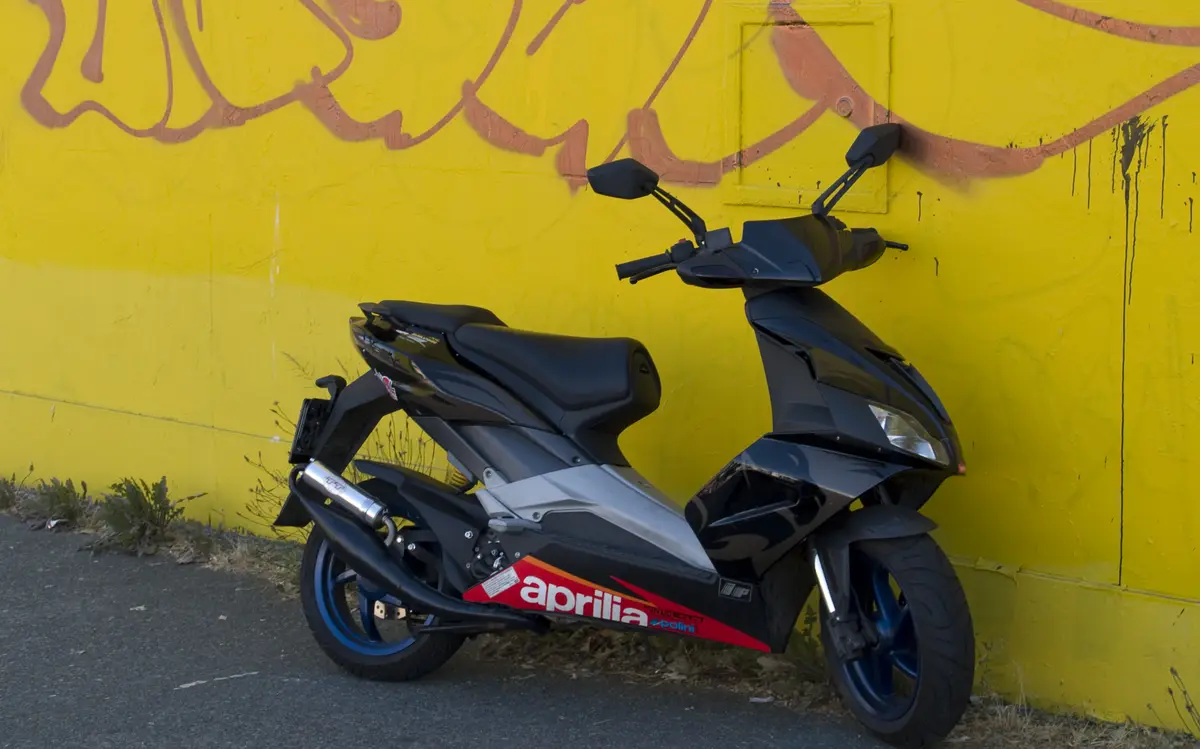
Aprilia SR 50 R Factory — photo by Nprefontaine, CC BY-SA 3.0, via Wikimedia Commons.

How did Aprilia DiTech work?

Air-assisted direct injection. A crank-driven compressor supplied air at around 5 bar to an air-fuel rail on the cylinder head; a conventional fuel injector metered petrol into that rail, and a direct injector fired the air-fuel mixture into the cylinder after the exhaust port had closed. Because the crankcase scavenged with plain air, fresh fuel could no longer short-circuit out of the exhaust port. An electric pump metered the two-stroke oil separately. The production hardware was built by Synerject, the Orbital–Siemens joint venture.

What did DiTech actually achieve?

On Aprilia's own launch figures: fuel consumption improved by 40% (50 km/l against a best of 29 km/l for a carburetted 50), oil consumption fell by 60%, and pollutant emissions fell by 80% against a traditional 50 cc two-stroke. Aprilia also claimed the system beat the Euro 1 limit by 50%, and the production DiTech met Euro 2 — the standard carburetted 50s were struggling to reach at all.

Which models used DiTech and Orbital direct injection?

Aprilia fitted DiTech to the SR 50 (from 2000) and the Scarabeo 50. Under Orbital licences the same technology appeared as Piaggio's PureJet (NRG) and Peugeot's TSDI (Looxor 50), and at sea in Mercury's OptiMax outboards and Tohatsu's TLDI range. Bombardier also licensed it for Sea-Doo watercraft in the early 2000s.

Was there ever a direct-injection two-stroke motorcycle?

Once — and not an Aprilia. Bimota's 500 V-Due of 1997 used its own direct-injection system, which never ran properly; owners were offered carburettor conversions, and the episode contributed to Bimota's bankruptcy. No DiTech motorcycle was ever made: by the time the system was proven, the road-going two-stroke motorcycle market it might have saved was already nearly gone.

What goes wrong with a DiTech today?

The documented weakness is water: the compressor system collected condensation in humid conditions, and Aprilia issued a retrofitted solenoid drain valve to purge it. Bikes without the fix suffered carbon-fouled spark plugs. Beyond that, the challenge is age — the electronics and injectors are Synerject parts from a system the industry walked away from, so diagnostics and spares take more hunting than a carburettor ever will.

Is DiTech the same thing as KTM's TPI?

No. TPI (Transfer Port Injection, launched on KTM's 2018 EXC models) puts two injectors in the transfer ports and meters fuel precisely, but the fuel still passes through the crankcase and there is no compressor and no direct injection into the chamber. DiTech kept fuel out of the crankcase entirely and injected into a sealed cylinder. TPI is the cheaper, simpler solution; DiTech was the more complete one.

Workshop resourcesBrowse manuals, downloads, and selected garage essentials. Support the archiveShare a correction, contribute knowledge, or get in touch.
Follow