
Yamaha RD350 Specifications: Full Spec Sheet, US vs. Indian LT/HT, and Every Variant Explained
Updated with verified factory and period-press data — the complete reference for the air-cooled Yamaha RD350, the Indian-built Rajdoot/RD350 HT and LT, and how they compare to the RD350LC and RD350 YPVS.
Search for yamaha rd350 or rd 350 yamaha and you'll find a lot of forum fragments and half-complete spec sheets. This page pulls the real numbers together in one place — engine, weight, top speed, mileage, and the differences between the US-spec RD350B and the Indian RD350 HT/LT — so you're not cross-referencing five tabs to confirm a single figure.
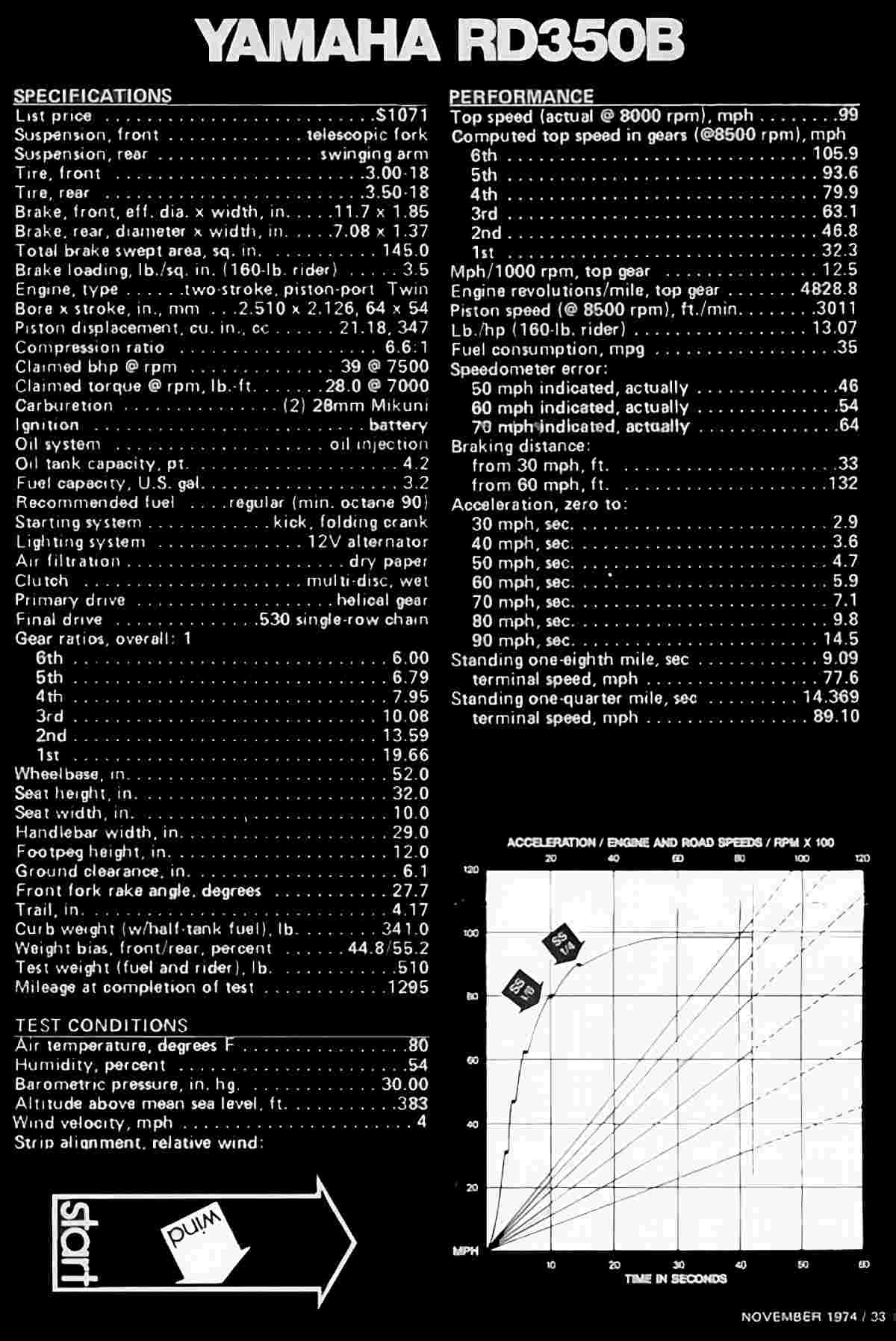
Yamaha RD350 Full Specification Sheet
| Spec | US-spec RD350B (1973–75) |
|---|---|
| Engine | 347cc (21.2 cu in) air-cooled, two-stroke parallel twin, reed-valve ("Torque Induction") |
| Bore × stroke | 64mm × 54mm |
| Compression ratio | 6.6:1 |
| Power | 39 bhp @ 7,500 rpm (≈32 bhp at the rear wheel) |
| Redline | 8,500 rpm |
| Transmission | 6-speed manual |
| Frame | Tubular twin-cradle |
| Front suspension | Telescopic forks |
| Rear suspension | Dual shock absorbers |
| Brakes | Front disc, rear drum (export markets) |
| Tires | Front 3.00×18, rear 3.50×18 |
| Wheelbase | 1,320mm (52 in) |
| Length × width × height | 2.04m × 0.835m × 1.11m |
| Seat height | 800mm (31 in) |
| Weight | 155kg (342 lb) wet |
| Fuel capacity | 15.5L (4.1 US gal) |
| Top speed | 105 mph (169 km/h) |
This is the RD350 engine specs and chassis data most enthusiasts mean when they say "RD350 specs" — the original Japan-built, US/export-market machine sold from 1973–75, badged RD350A in its first year and RD350B from 1974 (a distinction that matters if you're sourcing parts, since minor jetting and electrical differences exist between the two).
Yamaha RD350 Power, Torque, and BHP: US-Spec vs. Indian RD350 (HT/LT)
This is where rd 350 bhp and rd 350 power searches usually run into confusion, because "the RD350" actually covers two very different states of tune depending on where it was built.
US/export-spec RD350B: 39 bhp @ 7,500 rpm from the factory, front disc brake standard.
Indian RD350 (built 1983–1990 by Escorts Group under license, badged Rajdoot 350): detuned for local fuel quality and economy, and sold in two states of tune:

| Variant | Power | Notes |
|---|---|---|
| HT (High Torque) | ~30–31 bhp @ 6,750 rpm | Wider exhaust ports than LT; the version most associated with the RD's "Rapid Death" reputation in India |
| LT (Low Torque) | ~27 bhp @ 6,000 rpm | Introduced 1985, tuned for smoother low-end delivery and better economy |
Both Indian variants also swapped the export model's front disc for 150mm drum brakes front and rear, a cost and reliability decision for the Indian market rather than a performance one. If you're restoring an Indian-market bike and comparing it against rd350 us spec data, the drum-brake spec plus the HT/LT power figures above are the two biggest divergences from the US-spec sheet.
Top Speed, Acceleration, and Real-World Mileage
- Top speed: US-spec RD350B — 105 mph (169 km/h). Indian RD350 HT/LT — commonly reported around 150 km/h (93 mph), with race-prepared examples going considerably higher.
- Acceleration: period Indian road tests commonly cite 0–100 km/h in under 7 seconds and 0–150 km/h in around 16 seconds for the HT — genuinely quick for a 1980s Indian-market motorcycle, and part of why the RD350 built its reputation.
- Mileage: real-world fuel economy on the Indian-market bikes is widely reported between roughly 10–25 km/l depending on riding style and state of tune — the wide range reflects how sensitive a highly-tuned two-stroke twin is to throttle discipline.
Weight, Seat Height, and Dimensions
The US-spec RD350B weighs 155kg (342 lb) wet, with an 800mm (31 in) seat height and a 1,320mm wheelbase — dimensions that carried through largely unchanged to the RD350LC. Indian-market bikes are commonly listed around 143–150kg dry, reflecting minor equipment differences (drum brakes, tank capacity) versus the export model rather than a different frame.
What Is "Torque Induction"? Yamaha's Reed-Valve System Explained
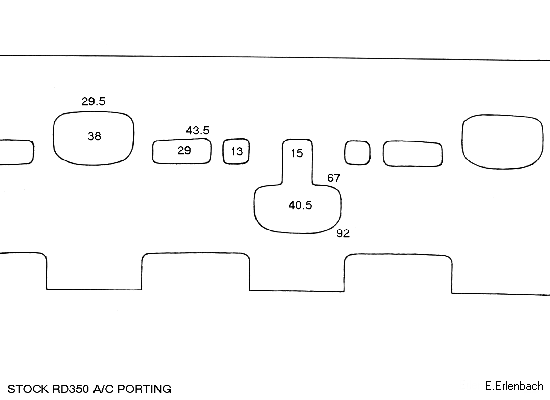
If you've searched yamaha torque induction or yamaha 350 torque induction, you've bumped into Yamaha's marketing name for the RD350's reed-valve induction system — not a separate engine or a trim level. The RD350B's owner's manual described it as a "new type engine," and mechanically it's a seventh port added to the standard six-port two-stroke layout, fitted with a thin, flexible reed valve that opens only when crankcase vacuum demands a fresh charge.
The practical effect: fuel/air mixture can't blow back out through the carburetor at low rpm the way it can on a piston-port two-stroke, which fills the crankcase more efficiently across a wider rev range. That's the origin of the "Torque Induction" name — it broadened the RD350's usable power band and made it noticeably more tractable in traffic than the R5 it replaced, without sacrificing the top-end power the RD was built around.
RD350 vs. RD350LC vs. RD350 YPVS: How the Specs Changed
The "RD350" name covers three distinct engine generations. If you're cross-shopping or trying to identify a bike from a spec sheet, this is the fast way to tell them apart:
| Model | Years | Cooling | Power | Key difference |
|---|---|---|---|---|
| RD350 (A/B) | 1973–75 | Air | 39 bhp @ 7,500 rpm | Original Torque Induction reed-valve twin; predecessor to the RD400 |
| RD350LC | 1980–83 | Liquid | 49 bhp | Same 64×54mm bore/stroke as the air-cooled RD350; liquid cooling and revised porting for emissions compliance |
| RD350 YPVS (sold as RZ350 in the US) | 1983–86 | Liquid | Factory power-valve tuning | Adds the YPVS power-valve system; later production moved to Brazil as the RD350R, built until 1995 |
If you're seeing rd350r in search results, that's this final Brazilian-built YPVS-derived variant — a different bike from the 1973–75 air-cooled original despite the shared "RD350" name, so double-check which generation a parts listing or spec sheet is actually describing before ordering anything.
Frequently Asked Questions
Is the Yamaha RD350 a twin-cylinder motorcycle? Yes — it's a 347cc air-cooled (or, on the LC/YPVS, liquid-cooled) parallel-twin two-stroke, in every generation from 1973 through the final Brazilian-built YPVS-derived models.
What was the last model year for the RD350? The original air-cooled RD350 ended production in 1975, succeeded by the RD400. The India-built Rajdoot/RD350 (HT and LT) ran from 1983 to 1990. The YPVS-derived line continued in Brazil, as the RD350R, until 1995.
What's the difference between the RD350 and the Yamaha RX 350? These are different, unrelated model families — if you found this page searching for RX-series specs, note that the RX line (RX100, RX135, etc.) is a separate smaller-displacement Yamaha two-stroke series, not a variant of the RD350.
Was the Indian RD350 the same as the export-market RD350B? Mechanically closely related — same 347cc, 64×54mm bore/stroke, reed-valve Torque Induction engine — but detuned in power (HT ~30 bhp, LT ~27 bhp vs. 39 bhp export-spec) and fitted with front and rear drum brakes instead of the export model's front disc.
Spotted an error or have a factory manual with different figures for your market? Get in touch — this page is maintained as a living reference for the RD350 community.