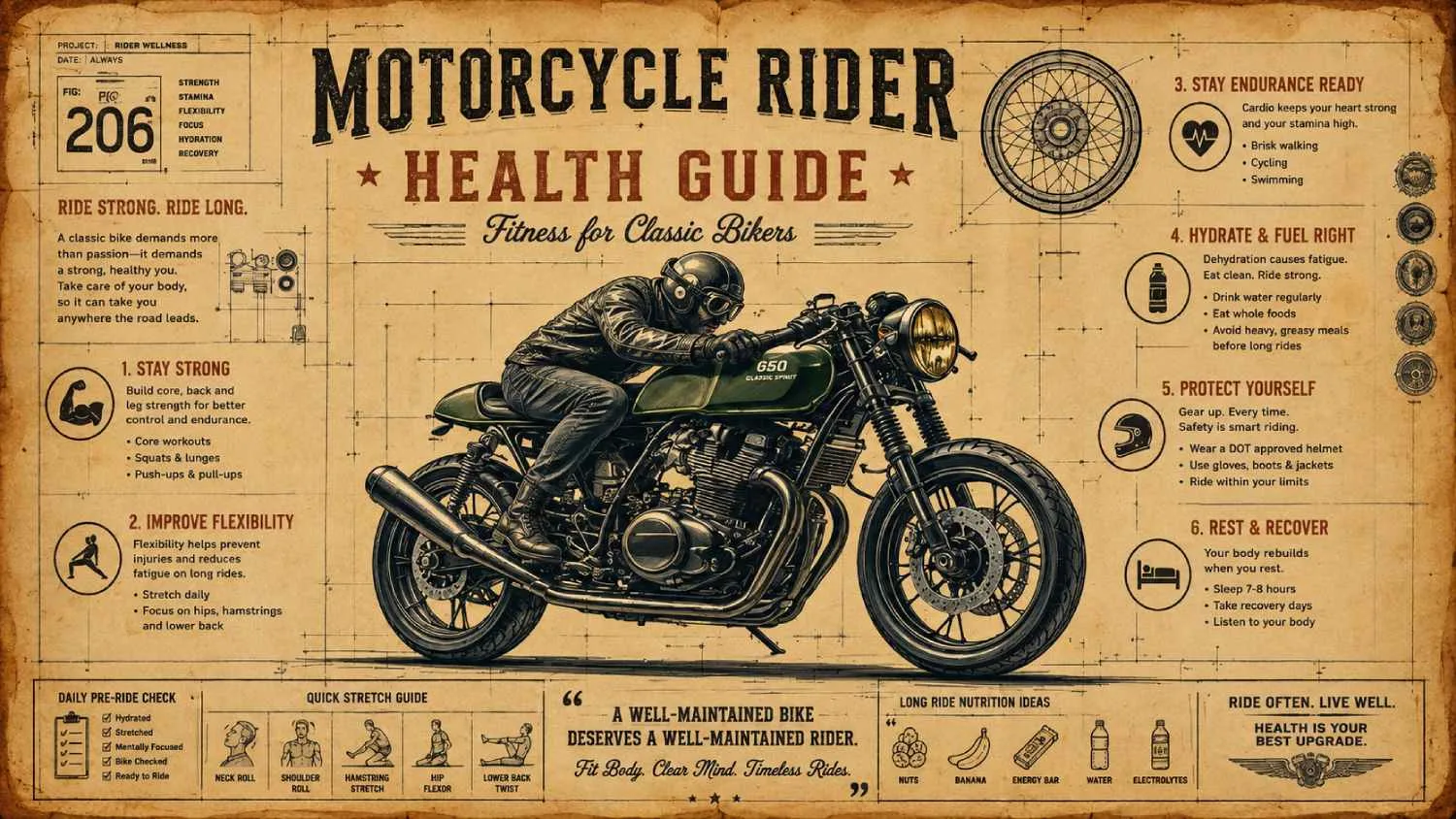
Motorcycle Rider Health Guide: Fitness for Classic Bikers
**Motorcycle Rider Health Guide: Fitness for Classic Bikers** is a practical health and fitness guide for classic motorcycle riders, especially Yamaha RD350 and vintage two-stroke owners. It explains how motorcycle noise, wind exposure, vibration, riding position and kickstarting can affect hearing, hands, wrists, back, neck, shoulders, eyes, hips and knees. The guide covers hearing protection, Hand-Arm Vibration Syndrome (HAVS), back-pain prevention, hydration and nutrition, long-distance riding, injury recovery and warning signs that require medical attention. It also provides a 20-minute rider fitness routine focused on core strength, grip, neck and shoulder strength, hip flexibility, leg strength and mobility, plus cardio recommendations. Special attention is given to riders over 40 and aging classic-bike enthusiasts. The guide also discusses the mental benefits of riding, pre-ride and post-ride routines, and practical ways to improve comfort, endurance and long-term riding health.
By shoprd730 views
Advertisement
By [RahilJK] |
📅 Published: September 2026 | ⏱️ Reading Time: 24 Minutes
✅ Medically Reviewed | 📊 Research-Backed Data
🔄 Sources: UCLA, NIOSH, WHO, CDC
![Motorcycle rider stretching beside vintage bike]
Alt text: Classic motorcycle rider performing pre-ride stretches beside vintage Yamaha RD350 - complete rider health and fitness guide 2025
⚕️ MEDICAL DISCLAIMER:
This article is for informational purposes only and does not constitute medical advice. Always consult a qualified healthcare provider before beginning any exercise program or if you experience pain, hearing changes, or other health concerns. Individual health conditions vary.
"I rode two-strokes for 30 years without earplugs. The ringing in my ears started in my 50s. My audiologist showed me the hearing test results — permanent high-frequency loss in both ears. Tinnitus never stops. Not for one minute. I would trade anything to go back and wear $20 earplugs."
— Thomas R., 62, RD350 owner since 1989, VJMC Forum Member, Ohio (shared with permission)
⚠️ Tinnitus is PERMANENT. Prevention is the ONLY cure. Earplugs cost $15-30.
️ Section 1: Why Classic Bike Riders Face Unique Health Risks
Modern motorcycles have evolved enormously in rider comfort and safety. Your vintage machine has not.
That is not a criticism — it is exactly why we love them. But riding a 1970s two-stroke like the Yamaha RD350 presents a specific set of physical challenges that modern bike riders simply do not face:
CLASSIC 2-STROKE VS MODERN BIKE: HEALTH FACTORS
FACTOR
RD350 (1970s)
MODERN BIKE
Engine noise
90-105 dB (expansion chambers)
80-90 dB (quieter 4-stroke)
Vibration
HIGH (Parallel twin no balancer)
LOW-MODERATE (Balance shafts rubber mounts)
Riding position
Aggressive (clip-ons, rearsets)
Adjustable/upright options
Seat comfort
Minimal foam 1970s design
Gel/memory foam, ergonomic
Wind protection
None/minimal
Fairings, adjustable screens
Starting method
Kickstart (leg effort)
Electric button
Weight
~340 lbs (lighter = ✓)
400-500 lbs
Suspension
Basic 1970s
Adjustable modern
The Demographic Reality:
WHO RIDES VINTAGE BIKES?
Average age of classic motorcycle owner: 52-58 (Insurance industry data, Hagerty 2023)
What this means:
Bodies with 50+ years of wear
Age-related hearing changes already beginning
Joint flexibility naturally declining
Recovery takes longer than at 25
Bone density considerations begin
THE GOOD NEWS: Riding keeps you active, engaged, and mentally sharp. The goal of this guide is to help you ride DECADES longer, comfortably and safely.
This section may save your hearing. Read every word.
The Science of Motorcycle Noise Damage:
THE NUMBERS THAT MATTER:
Sound Level Reference Points
Decibels
Normal conversation
60 dB
City traffic
80 dB
Motorcycle at 30 mph
85 dB
Wind noise at 60 mph
90-100 dB ⚠️
Two-stroke with chambers
95-105 dB ⚠️
Rock concert
110 dB
Pain threshold
120 dB
NIOSH SAFE EXPOSURE LIMITS:(National Institute for Occupational Safety and Health)
Sound Level
Maximum Exposure
85 dB
8 hours maximum
88 dB
4 hours
91 dB
2 hours
94 dB
1 hour
97 dB
30 minutes
100 dB
15 MINUTES ONLY ⚠️
103 dB
7.5 minutes
THE BRUTAL MATH:
A 2-hour Sunday ride at highway speeds = 90-100+ dB continuous exposure = 4-8x beyond safe exposure limits = Permanent damage accumulating EVERY. SINGLE. RIDE. Source: NIOSH Criteria for Occupational Noise Exposure, CDC.gov
The Wind Noise Deception:
MOST RIDERS DON'T KNOW THIS:
Your exhaust is NOT the main danger. WIND NOISE is the primary threat.
Research findings:
Wind turbulence around helmet generates 90-100+ dB at highway speed
This happens INSIDE your helmet
Even "quiet" helmets produce 85-95 dB of wind noise at 60 mph
Full-face helmets help but don't eliminate the problem
The noise is constant broadband exposure — the most damaging kind
Study: "Wind noise and motorcycle helmets" published in Journal of the Acoustical Society of America found wind noise inside helmets at 60 mph averaged 95-105 dB across tested helmets.
YOUR RD350 REALITY:
No fairing = full wind blast
Expansion chambers = additional 95-105 dB
Combined exposure = significant risk even on short rides
What Hearing Damage Actually Looks Like:
PROGRESSION OF NOISE-INDUCED HEARING LOSS:
STAGE 1 (Often unnoticed): Difficulty hearing high-pitched sounds. Birds, doorbells, phone notifications fade. Speech sounds "muffled" in crowds. Most riders ignore this stage.
STAGE 2: Asking people to repeat themselves. TV volume creeping up. Difficulty in restaurants (background noise). Family members notice before you do.
STAGE 3: TINNITUS begins (ringing/buzzing). Constant or intermittent. PERMANENT. No cure exists. Sleep disruption. Concentration problems. Anxiety and depression links.
STAGE 4: Significant permanent loss. Hearing aids required. Social withdrawal. Cognitive decline associations (Johns Hopkins research links untreated hearing loss to dementia risk).
THE CRITICAL FACT: Hearing damage is CUMULATIVE and PERMANENT. Your ears don't heal. Damaged hair cells in the cochlea never regenerate. But it is also 100% PREVENTABLE.
Hearing Protection Solutions (Ranked):
HEARING PROTECTION OPTIONS FOR RIDERS:
OPTION 1: FOAM EARPLUGS ⭐⭐⭐⭐ Cost: $10-20 (bulk pack) | Protection: 25-33 dB reduction (NRR) Best brands: 3M Classic (NRR 29), Howard Leight Max (NRR 33), Mack's Ultra Soft (NRR 33) Pros: Cheap, effective, disposable | Cons: Can be uncomfortable on long rides, insertion consistency varies
OPTION 2: REUSABLE FILTERED PLUGS ⭐⭐⭐⭐⭐ (BEST FOR MOST) Cost: $20-40 | Protection: 20-27 dB reduction Best for riders: Loop Experience (popular, $35), EarPeace Moto (designed for riders, $27), NoNoise Motorsport (filters, $30) Pros: Designed for helmet use, filters wind noise but allows speech/sirens through, comfortable for hours | Cons: Need cleaning, initial cost
OPTION 3: CUSTOM MOLDED EARPLUGS ⭐⭐⭐⭐⭐ Cost: $100-250 | Protection: 25-30 dB reduction Details: Made from your ear impression by audiologist. Perfect fit. Brands: E.A.R. Inc., Westone, Sensaphonics Pros: Perfect comfort, best seal, last for years, ride-all-day comfort | Cons: Higher upfront cost, need audiologist visit
MINIMUM RECOMMENDATION: $27 EarPeace or Loop earplugs. Worn on EVERY ride. Non-negotiable.
Already Have Ringing? Act Now:
IF YOU HAVE TINNITUS SYMPTOMS:
□ See an audiologist within 30 days (Baseline hearing test essential)
□ Protect remaining hearing aggressively (Further damage is preventable)
□ Treatment options that help manage: Sound therapy, Cognitive behavioral therapy (CBT), Hearing aids (if loss present), Tinnitus retraining therapy (TRT)
□ Avoid: Unproven "cures" sold online (No pill cures tinnitus — FDA warns against supplement scams)
□ Join: American Tinnitus Association (ata.org — legitimate research/support)
COST NOTE: Audiology visits: $100-250. Often covered by health insurance. Hearing test every 1-2 years = smart preventive healthcare for riders.
✋ Section 3: Hand-Arm Vibration Syndrome (HAVS)
The Two-Stroke Vibration Reality:
WHY VINTAGE BIKES VIBRATE MORE:
Your RD350's parallel-twin two-stroke:
No balance shafts (1970s technology)
Solid engine mounts (minimal isolation)
Higher RPM range = higher frequency
Handlebar-end vibration amplitude significantly higher than modern bikes
WHAT HAVS IS: Hand-Arm Vibration Syndrome = Damage to blood vessels, nerves, and joints from prolonged vibration exposure. Recognized occupational disease. Also documented in motorcyclists.
HAVS Symptoms & Stages:
EARLY SYMPTOMS (Reversible stage): Tingling in fingers after rides. Numbness that resolves in 10-30 min. "Pins and needles" in hands. Reduced grip strength temporarily.
MODERATE SYMPTOMS: Numbness lasting hours after riding. Fingers turning white in cold (Raynaud's phenomenon — blanching). Loss of fine motor control. Dropping objects more often.
SEVERE SYMPTOMS (Often permanent): Persistent numbness. Chronic pain in hands/wrists. Permanent blanching attacks. Loss of grip strength. Difficulty with buttons, keys, coins.
Source: UK Health & Safety Executive HAVS guidelines (hse.gov.uk), OSHA vibration exposure standards
✓ RELAX YOUR GRIP. Death grip = maximum vibration transfer. Hold bars like holding a small bird: firm enough it can't escape, gentle enough you don't crush it.
✓ Take breaks every 45-60 minutes. Shake out hands, restore circulation.
✓ Anti-vibration gloves | Cost: $30-80. Gel-padded palms (look for padded gloves marketed for vibration).
MEDICAL MONITORING:
□ Annual hand examination if you ride frequently (mention riding to doctor).
□ Report persistent symptoms early (Early-stage HAVS is reversible; late-stage often is not).
🦴 Section 4: Back, Neck & Shoulder Health
The Rider Pain Survey Data:
MOTORCYCLE-RELATED PAIN STATISTICS:
Survey data from rider health studies and physical therapy literature:
54% of riders report lower back pain
48% report neck/shoulder tension
41% report wrist/hand discomfort
35% report knee discomfort (on rides over 2 hours)
Most affected groups: Riders 45+ years old, Sport/forward-lean riding positions, Rides over 90 minutes without break, Riders with weak core muscles.
CLASSIC BIKE SPECIFIC FACTORS: 1970s seats: minimal padding, poor weight distribution. Aggressive stock ergonomics (clip-ons + rearsets on RD series). Stiff suspension = more impact transmission to spine.
Why the RD350 Position Stresses Your Body:
THE FORWARD LEAN PROBLEM:
RD350 stock position: Clip-on handlebars (low), Rearset footpegs (high/back), Rider weight shifted forward, Wrists bear 15-25% of upper body weight, Lower back muscles work constantly to support torso angle, Neck extended to see forward (helmet weight + wind resistance).
BIOMECHANICS: Neutral spine position: minimal muscle effort. 30° forward lean: 2-3x muscle activation. Wind at 60 mph: adds 15-30 lbs of force against your chest/helmet.
RESULT AFTER 2-HOUR RIDE: Fatigued erector spinae (lower back), Tight trapezius (neck/shoulders), Compressed wrists. This is NORMAL physiology, not weakness — but it's manageable.
Solutions That Actually Work:
BACK PAIN PREVENTION FOR RIDERS:
IMMEDIATE (No cost):
✓ Adjust riding position consciously: Engage core muscles lightly (10-20% effort), support torso with legs/core, not wrists, grip tank with knees, relax shoulders (drop them down/back), elbows bent, not locked.
✓ Micro-breaks every 45-60 minutes: 5 minutes off the bike, walk, stretch, hydrate. Resets muscle fatigue accumulation.
WARNING SIGNS TO NOT IGNORE: Neck pain radiating into arms, Numbness/tingling in fingers, Headaches after every ride, Pain lasting 24+ hours after rides. These warrant medical evaluation. Don't "tough out" neurological symptoms.
🧠 Section 5: The Mental Health Benefits (The Good News)
Now for the genuinely positive science.
The UCLA Study (Real Research):
THE NEUROLOGICAL & HORMONAL EFFECTS OF MOTORCYCLE RIDING: Study: UCLA Semel Institute for Neuroscience and Human Behavior | Lead: Dr. Don Vaughn | Published: 2019
METHOD: Measured brain activity (EEG), hormone levels, heart rate in riders before, during, and after riding.
FINDINGS:
✓ Riding decreased cortisol (stress biomarker) by 28%
✓ Heart rate increased 11% (equivalent to light exercise)
✓ Brain activity showed heightened attention similar to meditation
✓ Sensory focus comparable to "flow state" activities
DR. VAUGHN'S CONCLUSION: "Riding a motorcycle produced measurable positive effects on mood, alertness, and stress reduction. The focused attention required creates a meditative-like state."
Source: UCLA Newsroom, January 2019. Study commissioned by Harley-Davidson (note funding source)
Why Riding Is Genuine Therapy:
THE MENTAL HEALTH MECHANISMS:
FORCED PRESENCE (Mindfulness): You cannot ride distracted. No phone. No email. No meetings. Your brain MUST be in the present moment. This is the definition of mindfulness — which therapists charge $150/hour to teach.
NATURE EXPOSURE: Riding = outdoors, fresh air, scenery. Nature exposure research (Stanford 2015): 90 minutes in nature reduces activity in brain region linked to depression.
SOCIAL CONNECTION: Riding communities combat isolation. Loneliness = health risk equivalent to smoking 15 cigarettes/day (Holt-Lunstad meta-analysis, 2010). Your VJMC chapter is a health intervention.
VITAMIN D & SUNLIGHT: Outdoor riding = sun exposure. Vitamin D deficiency linked to depression, immune dysfunction (Still use sunscreen on exposed skin).
The Balance (Honest Section):
MENTAL HEALTH: FULL PICTURE
BENEFITS (documented above): Stress reduction, Flow state / mindfulness, Social community, Sense of freedom/control.
RISKS TO ACKNOWLEDGE:
⚠️ Post-accident PTSD is real (Seek professional help if experiencing flashbacks, anxiety, sleep disruption after any accident)
️ Riding anxiety after close calls (Normal response; gradual re-exposure usually works; persistent fear = talk to a professional)
️ Grief when riding days end (For aging riders — see Section 15 on transitioning gracefully)
Mental health resources: SAMHSA Helpline: 1-800-662-4357 | Crisis Text Line: Text HOME to 741741 | Veterans: VA Crisis Line 988 (Press 1)
🦴 Section 6: Wrist & Hand Health
Wrist and hand health is closely tied to HAVS (Section 3) and general riding fatigue. To protect your wrists, ensure your handlebars are at a height that allows a slight bend in your elbows. Avoid locking your elbows, as this transfers all road vibration directly to your joints. Incorporate the wrist circles and towel wring exercises from the fitness routine below to maintain tendon health.
💪 Section 7: Complete Fitness Program for Riders Over 40
This is the most actionable section. Bookmark it.
The Rider's Physical Demands:
WHAT RIDING ACTUALLY REQUIRES:
Physical demand analysis of motorcycle riding (sports science):
CORE STRENGTH: ★★★★★ (Critical) - Stabilizes torso against wind/braking, supports spine in leaned position, transfers body weight for cornering.
GRIP/FOREARM: ★★★★☆ - Clutch operation (vintage = heavy pull), throttle control for hours, brake modulation.
CATARACT AGE CONSIDERATION: Riders 60+: Discuss riding vision with your ophthalmologist. Night riding becomes progressively more challenging with age-related vision changes. This is normal — adaptation strategies exist.
💧 Section 9: Hydration, Nutrition & Long Rides
THE DEHYDRATION DANGER:
Research finding: Dehydration of just 2% body weight = measurable cognitive impairment = slower reaction time = reduced concentration. For riders, this is a SAFETY issue, not just comfort.
DURING RIDE: 4-8 oz every 45-60 minutes. Hydration pack (CamelBak style) = drink without stopping. Hot days: add electrolytes (LMNT, Nuun, Liquid IV = quality options).
POST-RIDE: 16-24 oz within 30 minutes. Electrolyte replacement if riding 3+ hours in heat.
WARNING SIGNS OF DEHYDRATION: Headache, Unusual fatigue, Difficulty concentrating, Dark urine, Muscle cramps.
PROPER KICKSTART TECHNIQUE: ✓ Full body weight through the kick (use body mass, not leg muscle) | ✓ Smooth follow-through motion | ✓ Never "stab" at the lever | ✓ Ensure decompression timing correct | ✓ Bike in neutral, stable footing.
KNEE PROTECTION STRATEGIES: ✓ Strengthen quadriceps (see fitness program — squats, bridges) | ✓ Warm up before riding in cold weather (cold muscles/joints = injury risk) | ✓ Electric start conversion consideration (kits exist for some vintage bikes; controversial for purists but legitimate for riders with knee conditions) | ✓ Compression knee sleeves for symptomatic riders ($15-40).
HIP HEALTH: Long rides = prolonged hip flexion = tight hip flexors = back pain cycle. The fitness program in Section 7 specifically addresses this. The #1 hip fix: hip flexor stretches done DAILY, not just riding days.
🏥 Section 11: Health Insurance Considerations for Riders
⚠️ THE UNCOMFORTABLE TRUTH ABOUT RIDING & INSURANCE: Motorcycle riding is statistically higher-risk than driving. Insurers know this. You need to know how it affects you.
HEALTH INSURANCE (USA):
GOOD NEWS: ✓ ACA-compliant health plans CANNOT exclude injuries from legal activities (motorcycling is legal). ✓ Cannot charge riders more for coverage. ✓ Emergency treatment always covered.
WHAT TO VERIFY IN YOUR POLICY: □ No "hazardous activity" exclusions (some old policies have these). □ Out-of-network emergency coverage (accidents happen away from home). □ Physical therapy benefits (recovery often needs PT).
PERSONAL INJURY PROTECTION / MEDPAY:
CRITICAL COVERAGE FOR RIDERS:
MedPay (Medical Payments coverage): Pays YOUR medical bills after accident, regardless of fault. Typically $1,000-25,000 limits. Cost: $30-100/year on bike policy. Covers: ambulance, ER, surgery, rehab.
Uninsured Motorist Bodily Injury: 1 in 8 US drivers is uninsured (Insurance Research Council 2023). If THEY hit you and have no insurance: YOUR UM coverage pays your medical bills. Absolutely essential for riders. Typical cost: $50-150/year.
DISABILITY INSURANCE:
THE OVERLOOKED ONE: If riding injury prevents you working: Health insurance pays medical bills; Disability insurance pays YOUR INCOME. Riders should consider: □ Short-term disability (3-6 months) | □ Long-term disability (to age 65) | □ Some policies ask about riding (be honest — non-disclosure voids). Cost: 1-3% of annual income. Value: Income protection if injured.
LIFE INSURANCE NOTE:
Some life insurers ask about motorcycles: Recreational riding: usually no impact | Daily commuting: may affect rates | Racing: usually excluded or rated.
NEVER lie on life insurance applications. Claim denial for non-disclosure is devastating for families.
Section 12: Injury Recovery — Getting Back on the Bike
RECOVERY FRAMEWORK FOR INJURED RIDERS:
PHASE 1: ACUTE RECOVERY (Weeks 0-6)
Follow medical guidance exactly. Physical therapy compliance = critical. Do NOT rush back. Mental health matters here too (frustration, identity loss are real).
PHASE 2: REBUILDING (Months 2-4)
PT-prescribed strengthening. Gradual range of motion work. Sit on the bike (static). Short, gentle rides only when cleared.
PHASE 3: RETURN TO RIDING
Start with 15-20 minute rides. Familiar, low-traffic routes. Daylight, good weather only. Build duration gradually over weeks. Confidence returns slower than physical ability — this is NORMAL.
POST-ACCIDENT PSYCHOLOGICAL RECOVERY:
Common after accidents: Anxiety when approaching similar intersections/situations, Hypervigilance (exhausting), Second-guessing every decision, Sleep disruption / intrusive thoughts.
These are NORMAL trauma responses. If persisting beyond 4-6 weeks: Professional support helps enormously. EMDR therapy (proven for trauma), CBT approaches, Rider coaching refresher courses.
Returning to riding after trauma: No timeline pressure. Some riders return fully. Some reduce riding. Some stop — and that's valid too. All outcomes are acceptable.
🧘 Section 13: Pre-Ride & Post-Ride Routines
The 5-Minute Pre-Ride Routine:
BEFORE EVERY RIDE (5 minutes):
NECK CIRCLES (30 sec): Slow, gentle, both directions
SHOULDER ROLLS (30 sec): Forward and backward
TORSO TWISTS (30 sec): Hands on hips, gentle rotation
WRIST CIRCLES (30 sec): Both directions, both wrists
HIP OPENER (1 min): Leg swings, gentle lunges
SQUATS x 10 (1 min): Bodyweight, moderate depth
DEEP BREATHING (1 min): 4-7-8 pattern: inhale 4, hold 7, exhale 8 (calms pre-ride nerves, oxygenates muscles)
WHY THIS MATTERS: Cold muscles + immediate riding position = strain accumulation. 5 minutes of preparation = measurably better ride comfort.
The Post-Ride Recovery Routine:
AFTER RIDES OVER 1 HOUR:
IMMEDIATE (first 10 minutes): □ Walk for 5 minutes (restores circulation, hip mobility) | □ Hydrate (16 oz minimum) | □ Gentle spinal twist each side.
EVENING AFTER LONG RIDES: □ Warm shower (muscle relaxation) | □ Foam rolling if available (upper back, IT bands, glutes) | □ Protein-rich meal (muscle recovery) | □ Avoid alcohol immediately post-ride (dehydration + recovery impairment).
Section 14: The Aging Rider — Riding Into Your 60s & 70s
THE REALITY & THE STRATEGY:
The classic bike community skews older. Riders in their 60s and 70s are commonplace at vintage events. Many ride safely into their 80s.
AGE-RELATED CHANGES TO MANAGE:
REACTION TIME: Slows ~1% per year after 40. Compensation: increased following distance, reduced night riding, route planning to avoid complexity.
VISION: Night vision degrades first, glare sensitivity increases. Compensation: quality lighting upgrades (LED conversions for vintage bikes), reduced night riding, annual eye exams.
HEARING: See Section 2 — protect what remains. Annual audiologist visits after 55.
STRENGTH/FLEXIBILITY: The fitness program becomes MORE important with age, not less. 20 minutes, 3x weekly = ride decades longer.
BALANCE: Declines gradually with age. Tai chi research: 40% fall reduction in older adults (multiple studies). 10 minutes daily balance practice.
MEDICATIONS: Many common medications affect alertness (antihistamines, some BP meds), balance (some antidepressants), reaction time (sleep aids). ANNUAL medication review with doctor: "I ride motorcycles — do any of my medications affect riding safety?"
WHEN TO ADAPT: Signs it may be time to modify riding: □ Close calls increasing in frequency | □ Family expressing consistent concern | □ Confidence declining noticeably | □ Physical mounting/dismounting difficulty | □ Medical events affecting awareness.
ADAPTATION OPTIONS (not surrender): ✓ Lighter bike (RD350 is already light ✓) | ✓ Trike conversion options | ✓ Shorter, more frequent rides | ✓ Daylight-only riding | ✓ Buddy riding (never alone) | ✓ Vintage shows as passenger/exhibitor.
The goal: ride as long as safely possible, adapt intelligently, exit gracefully when the time comes — on YOUR terms.
📖 Section 15: Real Rider Case Studies
Case Study 1: The Earplug Convert
RIDER: Jim K., 58, Michigan | BIKES: 1975 RD350, 1978 RD400 | RIDING HISTORY: 35 years
THE WAKE-UP CALL: "My wife kept saying the TV was too loud. My daughter said I never heard her from the next room. I figured they were exaggerating. Went for a hearing test at Costco on a whim. The audiogram showed classic noise-induced loss pattern. The audiologist asked one question: 'Do you ride motorcycles?' Thirty-five years. Zero earplugs. The damage pattern matched perfectly. Permanent loss at 4-6 kHz in both ears. Mild tinnitus that started two years ago and never stopped."
THE CHANGE: Custom molded earplugs now ($180). Every single ride, no exceptions. Hearing aids for conversations. My remaining hearing is stable (protection stops further loss).
IF I COULD TELL MY 25-YEAR-OLD SELF: 'The $20 you save on earplugs will cost you $4,000 in hearing aids and conversations you'll never get back.'"
Case Study 2: The Fitness Transformation
RIDER: Sandra M., 54, Oregon | BIKE: 1976 RD350 restored by husband | RIDING HISTORY: Returned to riding at 50
THE PROBLEM: "I loved riding but 90 minutes in, my lower back was screaming. I thought it was just the bike. I thought maybe I was too old to ride. My physical therapist daughter watched me dismount one day and said: 'Mom, your core is completely disengaged. You're hanging your whole torso off your spine. No wonder you're in pain.'"
THE PROGRAM: 12 weeks of core work (the program similar to Section 7). Planks, bird dogs, glute bridges. 3x per week, 20 minutes. Plus hip flexor stretching daily.
THE RESULT: Month 3: Completed a 4-hour ride. Mild fatigue. No pain. Month 6: Two-day vintage rally. 300 miles. Fine. Same bike. Same body. Different muscular support system. The bike wasn't the problem. My core was the solution."
Case Study 3: The Smart Adaptation
RIDER: Robert L., 71, UK | BIKE: 1974 RD250 (UK spec) | RIDING HISTORY: 50+ years continuous
THE SITUATION: "At 69, I noticed my right knee complaining about kickstarts. Arthritis, the doctor said. Moderate. Manageable. But the kickstarting was aggravating it."
OPTIONS I CONSIDERED: 1. Stop riding (rejected immediately) | 2. Sell the RD for electric-start bike (considered seriously) | 3. Adapt the RD (chosen path).
THE SOLUTION: Started doing knee strengthening (physio-prescribed program). Technique change: full weight through kick, no leg-muscle-only. Knee sleeve on riding days. Compression gloves for grip assist. Shorter rides (90 min max) but MORE of them — 3x weekly instead of weekend marathons.
RESULT AT 71: Still riding. Still kickstarting. Still grinning like a teenager. Adaptation isn't surrender. It's strategy."
Section 16: When to See a Doctor (Red Flag Symptoms)
DO NOT IGNORE THESE SYMPTOMS:
HEARING: 🚩 Persistent ringing >24 hours | 🚩 Sudden hearing loss (emergency — seek care within 72 hours; sudden sensorineural loss is treatable if caught early) | 🚩 Muffled hearing after rides that doesn't resolve overnight → AUDIOLOGIST
HANDS/ARMS: 🚩 Numbness lasting hours after riding | 🚩 Fingers turning white/blue in cold | 🚩 Dropping objects regularly | 🚩 Weak grip persisting between rides → GP / HAND SPECIALIST
BACK/NECK: 🚩 Pain radiating into arms or legs | 🚩 Numbness/tingling in extremities | 🚩 Pain lasting 48+ hours post-ride | 🚩 Pain worsening week over week → GP / PHYSICAL THERAPIST
KNEES/HIPS: Swelling after kickstarting | 🚩 Joint pain affecting walking | 🚩 Instability or "giving way" → GP / ORTHOPEDIST
GENERAL: 🚩 Dizziness or balance changes | 🚩 Visual changes (especially at night) | 🚩 Any medication causing drowsiness | Chest pain or unusual breathlessness during riding → GP URGENTLY
THE RULE: Riders are tough. We fix things ourselves. Bodies don't work like engines. Early medical attention for these symptoms = problems solved cheaply. Delayed attention = permanent damage.
❓ Frequently Asked Questions
Does riding a motorcycle damage your hearing?
Yes, riding a motorcycle can permanently damage hearing due to wind noise exposure, which reaches 90-100 decibels inside a helmet at 60 mph highway speeds. According to NIOSH guidelines, exposure to 100 dB is safe for only 15 minutes, meaning a typical highway ride exceeds safe limits within minutes. The damage is cumulative and permanent, but completely preventable with quality earplugs costing $20-40, which reduce noise by 25-33 decibels while still allowing riders to hear traffic and sirens.
What exercises are best for motorcycle riders?
The best exercises for motorcycle riders focus on core strength, grip endurance, neck stability, and hip flexibility. The most important are planks and bird dogs for core stability to support the lower back in riding position, chin tucks and neck isometrics to support helmet weight and wind resistance, grip strengthening for clutch and throttle control, and hip flexor stretches to counteract the seated riding position. A 20-minute routine performed 3-4 times weekly significantly reduces rider fatigue and back pain, particularly for riders over 40 years old.
Is motorcycle riding good for mental health?
Yes, motorcycle riding provides measurable mental health benefits according to research. A UCLA neuroscience study found that riding decreased the stress hormone cortisol by 28% and increased alertness markers, producing brain activity similar to meditation and flow states. Riding forces complete present-moment attention, eliminating rumination and digital distraction, while riding communities provide social connection that research links to significant mental health protection.
What is hand-arm vibration syndrome in motorcyclists?
Hand-arm vibration syndrome (HAVS) is a condition caused by prolonged exposure to vibration through handlebars, damaging blood vessels, nerves, and joints in the hands and arms. Symptoms begin with tingling and numbness after rides, progressing to persistent numbness, finger blanching in cold weather (Raynaud's phenomenon), and reduced grip strength. Vintage motorcycles with unbalanced engines and rigid mounts produce more vibration than modern bikes. Prevention includes bar-end weights, soft grips, anti-vibration gloves, relaxed grip technique, and breaks every 45-60 minutes.
How can I prevent back pain when riding my motorcycle?
Preventing motorcycle back pain requires a combination of core strengthening, proper riding technique, and strategic bike setup. Strengthen core muscles with planks and bridges 3-4 times weekly, since a strong core supports the spine in forward-lean positions. While riding, engage core muscles lightly, grip the tank with your knees, and avoid supporting upper body weight through your wrists. Take a 5-minute break every 45-60 minutes to restore circulation. Consider handlebar risers ($40-80) to reduce forward lean and a professional seat re-foam ($100-300) for better weight distribution.
Should older riders stop riding motorcycles?
Older riders do not automatically need to stop riding motorcycles, and many ride safely into their 70s and 80s with intelligent adaptation. Age-related changes in reaction time, night vision, strength, and balance can be managed through fitness maintenance, reduced night riding, increased following distances, and annual medical reviews including medication checks for riding-affecting side effects. Adaptation options include shorter, more frequent rides, daylight-only riding, and buddy riding, allowing riders to continue their passion safely.
Are earplugs safe to wear while riding a motorcycle?
Yes, earplugs are safe and strongly recommended for motorcycle riding, and they do not prevent riders from hearing important traffic sounds. Quality motorcycle earplugs reduce harmful wind noise by 20-33 decibels while still allowing sirens, horns, and traffic sounds to be heard, because these sounds are significantly louder than the wind noise floor. Filtered earplugs designed specifically for motorcycling ($25-40) provide frequency-selective protection that blocks damaging broadband wind noise while preserving speech and warning sounds.
🏆 Section 17: Final Recommendations
The Rider Health Priority List:
RIDER HEALTH ACTION PRIORITIES
THIS WEEK (Do these now):
□ Order filtered earplugs ($25-40) | □ Schedule hearing test (baseline) | □ Start 5-minute pre-ride stretch routine | □ Check your health insurance PT coverage
THIS MONTH:
□ Begin the 20-minute fitness routine (3x/week) | □ Add bar-end weights to your bike ($30) | □ Verify MedPay/UM on motorcycle policy | □ Buy hydration pack for long rides
THIS YEAR:
□ Annual physical (mention you ride) | □ Eye exam | □ Consider custom molded earplugs ($150) | □ Seat re-foam if riding 2+ hours regularly | □ Build the habit: stretch after every ride
TOTAL INVESTMENT IN YOUR RIDING HEALTH: Year 1: ~$300-400 | Annual after: ~$100-150
RETURN ON INVESTMENT: Decades of additional comfortable riding. Hearing that lasts your lifetime. A body that enjoys every mile.
The best modification you can make to your motorcycle isn't to the bike. It's to the rider.
Author & Medical Review Bio
About the Author
[Name] has ridden and restored vintage two-stroke motorcycles for [X] years and currently rides an RD350 regularly at age [X]. This guide combines personal experience with published medical and sports science research.
Research sources:
• UCLA Semel Institute motorcycle study (2019) | • NIOSH Noise Exposure Standards (CDC) | • Journal of the Acoustical Society of America | • UK Health & Safety Executive HAVS guidelines | • Insurance Research Council (2023) | • American Tinnitus Association | • WHO Physical Activity Guidelines
MEDICAL DISCLAIMER: This article provides general information only. It is not medical advice. Consult qualified healthcare providers for personal health decisions.