
By Rahil "TorqueInductions" — I restore Yamaha two-strokes in my own garage (an air-cooled RD350, an RX100 and a Jawa 250); the Powervalve codes are the part of RD ownership where I've watched the most buyers get burned. More about me →
Two RD350 Powervalves, side by side in the classifieds, same money, same colours. One is a 1983 31K. The other is a 1986 FII wearing early bodywork. The adverts won't tell you they're different motorcycles under the skin, sharing almost nothing that matters. The frame number will — if you know how to read it. This is the map.
Why the codes exist at all
Yamaha changed the Powervalve constantly: frames, engines, carburation, electrics, bodywork, sometimes mid-generation. The model code — the prefix stamped at the start of the frame and engine numbers — is how the factory kept track, and it's how you should too. Parts books are organised by it. A CDI, a stator, a set of barrels: all code-dependent. Buy by year and colour alone and you will, eventually, buy an expensive ornament. The background on the family itself is in our history of the RD name; this piece is the Powervalve chapter, decoded.
31K — the first Powervalve (1983–84)
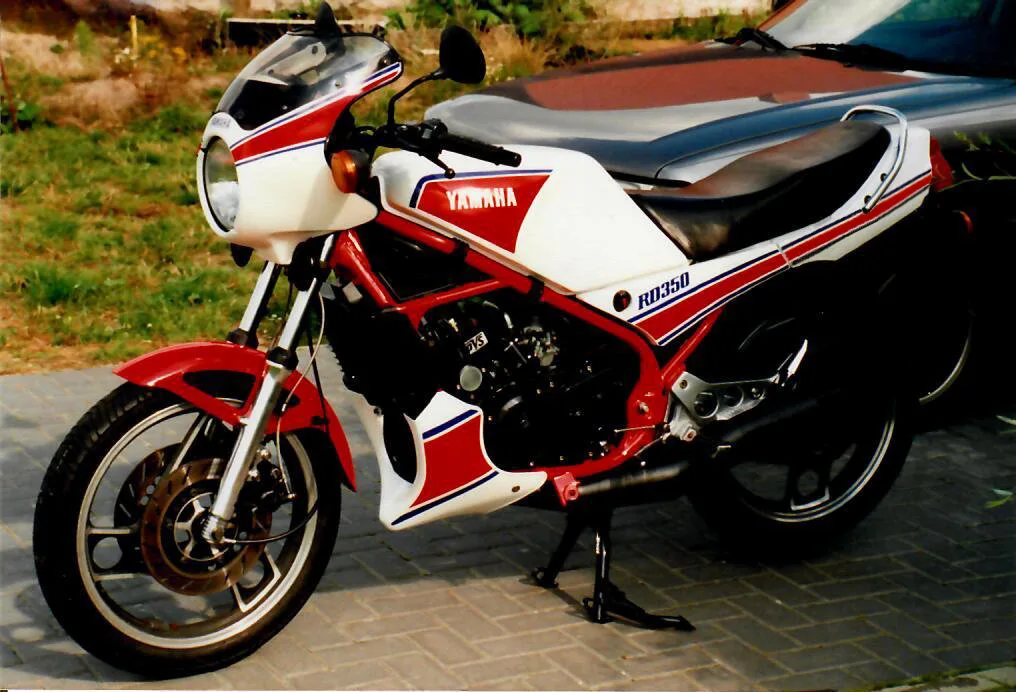
April 1983: the RD350LC II lands with the YPVS exhaust power valve — a servo-driven spool valve that varies the exhaust port height with revs, filling in the two-stroke's midrange hole. New frame, a rear disc at last, and a claimed 59 bhp, a dozen more than the Elsie it replaced. The 31K wore a nose fairing and bellypan as standard in most markets. These are the Powervalves purists chase, and the ones whose values have climbed hardest.
Originality traps: everything. The 31K's electrics are its own generation, its barrels are power-valve originals, and a 31K engine in a later frame (or the reverse) is a bitsa whatever the logbook says. Check that the engine prefix matches the frame prefix. Sellers of genuine matched bikes will be delighted you asked.
57V and 1JF — the one-year F and N (1985)
For 1985 Yamaha split the range: the F got a full fairing (code 57V), the N went naked (1JF), both still numbered in the 31K series underneath. They lasted a single year, which makes them the rarest standard Powervalves — and means their bodywork, especially the F's fairing panels, is the hardest to replace. A cheap "1985 F" missing its fairing is not the bargain it appears; the fairing is most of the point and much of the value.

1WT / 1WA — the FII and NII (1986 on)
1986 brought the real second generation. The FII (1WT) and NII (1WA) received a thoroughly revised engine: power-jet carburettors on these models, the infamous "bean can" silencers, revised porting, and a claimed 63 bhp. More important for owners is what happened to the electrics. The 1986-on ignition generation is the one stamped 1UA on the CDI unit — "1UA" is the code you'll hear most after 31K — and the stator and rotor changed with it. An '86-on stator only works with its matching rotor; a 31K can run a 1UA CDI with the earlier charging hardware, but mixing stators and rotors across the divide produces a bike that sparks weakly or not at all. Half the "electrical gremlins" in Powervalve classifieds are this paragraph, unlearned.