
Category: History

Yamaha FS1-E "Fizzie": The 49 cc Moped That Ruled 1970s British Youth

The Yamaha FS1-E — the "Fizzie" — is a 49 cc air-cooled two-stroke sports moped with a rotary disc-valve engine, a four-speed gearbox and bicycle pedals, built for the UK after the December 1971 "Sixteener Law" limited 16-year-olds to sub-50 cc mopeds. Yamaha quoted 4.8 bhp at 7,000 rpm and 45 mph for the unrestricted bike. It was launched in August 1972 badged SS ("Sixteener Special") and renamed FS1-E in January 1973, the E standing for England; the base FS1 was a Dutch-market five-speed motorcycle sold from 1969. Machines registered from 1 August 1977 were restricted to 30 mph and the classic era ended, though the model ran into the early 1980s and was revived in 1987. About 200,000 were produced for the UK market.

Yamaha FS1-E "Fizzie": The 49 cc Moped That Ruled 1970s British Youth

By Rahil (TorqueInductions) — I restore and ride Yamaha two-strokes here in India: an RD350 and an RX100 in my own garage, plus a Jawa 250. The Fizzie never officially came to India and I have never owned one, so this is written as an admirer of the family tree — the FS1-E is the bottom rung of the Yamaha two-stroke ladder, and a generation of British riders climbed from it straight onto RDs.

Ask a British rider of a certain age about his first bike and there's a fair chance he won't name a motorcycle at all. He'll say "Fizzie" — and then he'll probably do the noise. The Yamaha FS1-E was legally a moped and spiritually nothing of the sort: a proper little motorcycle with a tank between your knees, a four-speed gearbox and a disc-valve two-stroke engine, wearing a set of bicycle pedals it plainly did not want. It turned a loophole in the law into a rite of passage, and it became — Wikipedia's sport-moped article says it flatly — the most famous of all the "sixteener specials".

My interest is the family tree. Everything on this site starts with Yamaha's small two-strokes, and the FS1-E is where the ladder begins: the bike a British sixteen-year-old rode for a year and then traded up to an RD125, an RD250, an RD350. The small-capacity end of that story is now covered by the golden era of two-strokes at the big end; this is the 49 cc end, and it deserves the same care.

A Law Wrote the Spec Sheet

Until December 1971, a British sixteen-year-old could ride a motorcycle of up to 250 cc on L-plates. The "Sixteener Law" — brought in by Transport Minister John Peyton and effective from 15 December 1971 — ended that overnight. Sixteen-year-olds were limited to mopeds until seventeen, and a moped was defined as a two-wheeler of less than 50 cc fitted with pedals that could drive the machine.

Most manufacturers heard "moped" and built something apologetic. Yamaha heard the same word and looked at what it already had: the FS1, a light, disc-valved 50 cc motorcycle that had been selling in the Netherlands since 1969. Add pedals, adjust the specification for Britain, and you had a sports moped — a motorcycle in everything but the paperwork. The classic-insurer Footman James, in its buying guide, calls the trick exactly what it was: "a pedal system in place of footrests on a 50cc motorcycle, and thus comply with the law's definition of a moped".

Yamaha FS1-E Specifications

The spec sheet is a real motorcycle's spec sheet, shrunk. Pressed-steel backbone frame, telescopic forks, 17-inch spoked wheels, a kick-starter and a 16 mm Mikuni — with a pair of pedal cranks where the footrests should be.

SpecificationYamaha FS1-E (unrestricted, 1972–77)
Engine49 cc air-cooled two-stroke single, rotary disc-valve induction
Bore × stroke43.0 mm × 39.7 mm
CarburettorMikuni VM16SC, 16 mm
Power4.8 bhp @ 7,000 rpm (Yamaha's quoted figure)
Gearbox4-speed (the Dutch FS1 motorcycle had five)
FramePressed-steel backbone
BrakesDrums front and rear; front disc on the DX from 1975
Weight70 kg dry
Tyres2.25-17 front, 2.50-17 rear
Top speed45 mph (Yamaha's quoted figure)
Economy95 mpg or more (period spec)
OilPremix at 20:1 on early bikes; Autolube injection on later models

The numbers in context: the full Yamaha small-bike picture, from this 49 cc single up through the LC twins, is lined up on the RD specifications page. What the table can't show is the proportions — 69 inches long, 22 inches wide, 70 kilos. A modern 125 cc scooter is a bigger, heavier vehicle than the machine Britain's teenagers treated as a full-sized motorcycle.

Yamaha FS1-E Fizzie specifications infographic — 49cc rotary disc-valve two-stroke, 43 by 39.7mm bore and stroke, 4.8 bhp at 7,000 rpm, four-speed gearbox, 70kg, 45 mph, 1972 to 1977 unrestricted

From Dutch FS1 to British Sixteener Special

The FS1-E's name tells its own story in two parts. The bike underneath was the FS1, Yamaha's disc-valved 50, on sale in the Netherlands from 1969 as a small motorcycle — five-speed gearbox, no pedals, no apologies. For Britain it was downtuned to four speeds, given the pedal mechanism, and fitted with cycle parts shared with other UK-market Yamahas. The suffix marked the market: E for England.

The launch has a wrinkle most retellings miss. The bike arrived in British showrooms in August 1972 badged simply "SS" — for "Sixteener Special" — in Candy Gold. Honda objected: it already sold an SS50, and one SS was quite enough. So in January 1973 Yamaha renamed its bike FS1-E, and the "Fizzie" nickname did the rest. That is why honest sources disagree about whether the FS1-E was "launched in 1972" or "in 1973" — both are true, depending on whether you date the bike or the badge.

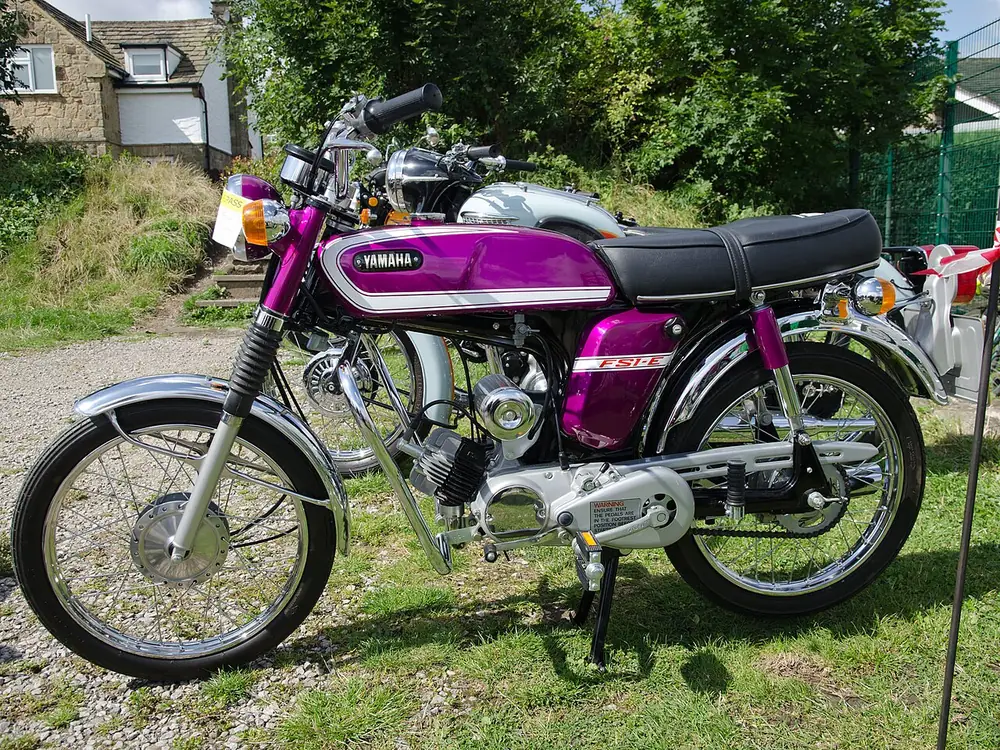
The colours became part of the identification game. Candy Gold (or Candy Orange, depending on whose period literature you read) for the SS and earliest FS1-Es, then Popsicle Purple from 1974 — the colour of the bike in our photograph — with Baja Brown and Competition Yellow among the later seventies finishes, and speedblock graphics arriving as the decade wore on.

The Pedals: A Legal Fig-Leaf That Seized Solid

The pedal mechanism is the FS1-E's party piece, and the Vintage Japanese Motorcycle Club's description of it is the clearest going. Both pedal cranks could be rotated forward so the pedals formed ordinary motorcycle footrests — their normal position, and the one every rider used. To actually pedal, you rotated the left-hand crank back and locked it, engaged a drive gear, and a short chain connected the pedal drive to the main engine drive.

It was, by every account, miserable: no freewheel, very low gearing, and the engine could even be started with the pedal drive engaged, the pedals rotating under power in gear. The VJMC's verdict is the one owners repeat: "in practice, the cam and shaft arrangement to engage the pedals frequently seized" — because no rider ever used it. It was less tiring to push the bike than to pedal it. The mechanism existed to satisfy a definition, and once it had satisfied the definition on the showroom floor, it seized in peace. Any FS1-E you look at today with a free-moving pedal mechanism has had an unusually conscientious owner.

Fizzie vs the Rest: Honda SS50 and Suzuki AP50

Yamaha was not the only factory working the loophole. Honda's SS50 — the bike whose name forced the FS1-E rename — was a four-stroke, and in Fowlers' "Four Fast Fifties" comparison it "couldn't quite keep up with the two-stroke competition in the traffic light grand prix". Suzuki arrived later with the AP50, developed from its A50: the same 4.8 bhp from 49 cc, but with a five-speed gearbox — one more than the Fizzie — and a shade more torque. The European houses (Puch, Fantic, Gilera, Garelli) built their own sports mopeds for the same law-shaped market.

The FS1-E won the era anyway — on looks, on the Yamaha dealer network, and on being first and best-marketed. Visordown's "Bike Icon" piece notes it was launched as a sports moped and "was the first of its kind"; Suzuki's AP50, when it came, resembled the Fizzie almost part for part, bicycle pedals included. Imitation is the sincerest form of market research.

1975 Onwards: A Disc Brake, Autolube and Speedblocks

The FS1-E was developed like a motorcycle, not frozen like a moped. For 1975 came a mildly revised model — the FS1-E D — with new forks, revised switchgear and a front disc brake, at £199 according to Carole Nash's history of the model. The disc-brake version is the DX, and a genuine front disc on a 50 is still the quickest way to spot a mid-seventies bike across a show field.

The other upgrade mattered every single ride. Early Fizzies ran on premix at 20:1 — petrol and two-stroke oil mixed in the tank, the way the period spec sheets list it. Across the later seventies Yamaha adopted its Autolube oil-injection system for the model, with a separate oil tank and a pump doing the mixing for you. If you know the RD family, you know that divide well: premix is simple and honest, Autolube is civilisation. Which side of it a Fizzie sits on is one of the first things to establish when you look at one for sale.

August 1977: The Law Comes Back

The sports mopeds had complied with the letter of the 1971 law and ignored its spirit at 45 mph, and in the end the lawmakers noticed. From 1 August 1977, the moped definition changed again: the pedal requirement was deleted, but machines registered from that date were restricted to a maximum design speed of 30 mph (Wikipedia's FS1 article phrases the limit as 31 mph / 50 km/h), with a 250 kg weight limit alongside.

Yamaha rolled with it — the restricted successor was the FS1-M — but the era was over. A 30 mph Fizzie was transport; a 45 mph Fizzie had been a motorcycle. Classic Mechanics' buying guide closes the classic story plainly: "Sales struggled on until 1983, when the Fizzy, as it was known and loved, ended production." The unrestricted 1972–77 bikes — five model years — are the ones the whole legend rests on.

Tuning Culture: Pipes, Big-Bore Kits and Pub Numbers

A generation of sixteen-year-olds with a tunable two-stroke did exactly what you would expect. Visordown records that the Fizzie "became a hotbed of aftermarket tuning parts — big-bore kits, whippy exhausts and more", and that the bike could be returned to standard fairly easily and cheaply, which is half of why so many survived to be restored. Some owners even fitted the engine from the YB100 — the bigger Yamaha single whose chassis had borrowed FS1-E components in the first place.

The numbers need handling honestly. Yamaha quoted 45 mph. Visordown says tuned examples did "about 55 mph", and Fowlers repeats the ex-owner claim of "60+" with the right note of caution: "as many ex-owners will tell you". Those are period claims, not instrumented tests, and every Fizzie speedometer in Britain was an optimist. What is true is that the tuning method is the small-bike version of the one this site is built on: exhaust first, then jetting to match, one change at a time — the discipline in our RD350 carburetor tuning guide applies directly, and the carburetor jetting calculator will sanity-check a jetting change on the little VM16SC just as it does on a VM28.

The Long Fade — and the 1987 Comeback

After 1977 the FS1-E lived a quieter life: restricted FS1-M models, new frame prefixes, a bigger square tank on the later bikes, and sales that struggled on into the early eighties. Wikipedia puts total UK-market production at about 200,000 machines — a huge number for a single learner model, and the reason the Fizzie defined the era rather than merely taking part in it.

Then Yamaha did something it almost never does. In 1987 it reintroduced the Fizzie — Bonhams' auction notes call the revival "an almost unprecedented occurrence". The new bikes kept the original look but were restricted, pedal-less and Autolube-equipped, and — Visordown notes the oddity — went back to drum brakes at both ends despite the otherwise modernised specification. Production of the revival ran into the early nineties. A moped so fondly remembered that the factory built it twice: there is no cleaner measure of what the FS1-E meant.

Buying a Fizzie Today: Read the Frame Prefix First

The Fizzie restoration scene is mature — an owners' club (the FS1-E Owners Club), a busy fs1e.co.uk community, rallies, and a pattern-parts trade that exists precisely because demand never died. What to check matters more than what to pay, because values swing wildly with year and originality:

  • Frame prefix first. The owners' record is consistent: 394 prefixes are the pedal models, all unrestricted (1972–77 — the legend years). 2GO is the restricted FS1-M (1977 on). 3F6 covers the later square-tank bikes and the 1987–92 revival. The prefix tells you which law the bike was built under before you even start it.
  • Pedals: present and correct. On a 394 bike the pedal cranks, the locking cam and the little drive chain should all be there. Seized is normal and fixable; missing is a negotiation.
  • Disc or drum? A front disc means a DX from 1975 on (or a retro-fit — check the forks and switchgear match the story). The 1987 revival bikes went back to drums, so a drum does not by itself make a bike early.
  • Premix or Autolube? Establish which oil system the bike has and whether the pump side is complete on an Autolube bike. An engine run on straight petrol by a confused owner is a crank-seals-and-bore conversation.
  • Originality beats shine. Candy Gold SS-badged bikes and Popsicle Purple 394s are the blue-chip Fizzies. A correctly badged, correctly coloured unrestored bike is worth more than a prettier wrong one.

Yamaha FS1-E buying checks infographic — frame prefixes 394 unrestricted pedal models, 2GO restricted FS1-M, 3F6 later and 1987 revival bikes, disc brake DX, premix versus Autolube checks

The Baby Brother of the RD Family

Why does a 49 cc British moped earn a long page on an RD site? Because the ladder is the story. The Fizzie rider turned seventeen, passed his test, and bought the next Yamaha up: an RD125 twin if he was sensible, something bigger if he wasn't. A few years later the same rider, licensed for anything, watched Yamaha shrink the LC formula all the way down to the RD80LC — a learner bike wearing the full RD350LC dress, built for Europe's 80 cc classes by exactly the same law-shaped logic that had created the Fizzie a decade earlier. Different country, different decade, same trick: when the law writes a small box, Yamaha builds the most motorcycle that fits inside it.

That is the FS1-E's real legacy. Not the pedals, not the 45 mph — the proof, at 49 cc, that a learner bike did not have to be an apology. Every rider who started on one and stayed on bikes for life is the receipt.

Yamaha FS1-E in Popsicle Purple (1975) — photo by SG2012, CC BY 2.0, via Wikimedia Commons

Frequently Asked Questions

What does the E in FS1-E stand for?

England. The FS1-E was the UK version of Yamaha's FS1 — the E marked it as the England model, with pedals for the UK moped law, a four-speed gearbox in place of the motorcycle's five, and cycle parts shared with other UK-market Yamahas. Other markets got their own suffixes, such as the Dutch FS1P/DX.

How fast is a Yamaha FS1-E?

In unrestricted 1972–77 form, Yamaha quoted 45 mph, and the VJMC's specification gives a maximum speed of 40–45 mph — with 4.8 bhp at 7,000 rpm pushing 70 kg, that's a believable period figure. Tuned bikes were claimed to reach 55 mph or more, but those are owners' claims, not tested figures. Machines registered from 1 August 1977 were restricted to a 30 mph design speed by law.

When was the Yamaha FS1-E made?

The bike was launched in the UK in August 1972 badged SS ("Sixteener Special") and renamed FS1-E in January 1973 after Honda objected to the SS name. The unrestricted pedal models ran to August 1977; restricted FS1-M versions continued into the early 1980s, with the classic line usually dated to 1983. Yamaha then revived the FS1-E in 1987, and the revival ran into the early nineties.

Why does the Yamaha FS1-E have pedals?

Because the law said so. From 15 December 1971, a UK moped had to be under 50 cc and fitted with pedals capable of driving the machine. Yamaha's cranks swung forward to serve as footrests in normal riding; swung back and locked, a small chain drive let you pedal — slowly, with no freewheel. Owners almost never used them, and the engagement mechanism commonly seized. The pedal requirement itself was dropped in the August 1977 law change.

What is the difference between the Yamaha FS1 and the FS1-E?

The FS1 was a Dutch-market light motorcycle sold from 1969: 49 cc disc-valve two-stroke, five-speed gearbox, no pedals. The FS1-E was its British derivative — pedals added to meet the UK moped definition, a four-speed gearbox, UK-market cycle parts, and the E suffix for England. Same engine family, same looks; one was a motorcycle, the other was a motorcycle wearing a legal costume.

What oil does a Yamaha FS1-E run on?

It depends on the year. Early bikes are premix machines: the period specification is a 20:1 mix of petrol and two-stroke oil in the tank. Later-seventies models adopted Yamaha's Autolube oil injection, with a separate oil tank and pump — no mixing, but the pump and its lines need checking on any bike that has sat. Establish which system your bike has before its first start in your ownership.

Workshop resourcesBrowse manuals, downloads, and selected garage essentials. Support the archiveShare a correction, contribute knowledge, or get in touch.
Follow