By Rahil "TorqueInductions" — I own and restore an RD350, an RX100 and a Jawa 250; the 250LC is a bike I know from the other side of the parts counter and the paddock fence, as an enthusiast rather than an owner. More about me →
In 1980 a British seventeen-year-old with a provisional licence had a problem money could solve beautifully. The law said 250 cc. Yamaha said: fine — here's 247 cc of liquid-cooled two-stroke that goes like a 400. The RD250LC didn't just sell; for about three years it was the object of desire in every school bike shed in Britain.
It helps to understand what the LC generation replaced. The air-cooled RD250 had been a good bike, but the LC was a different species — I've covered what the RD name itself means elsewhere on the site, and the LC twins were where that badge peaked. The 250 shared almost everything with the RD350LC that hogged the headlines: the same liquid-cooled, reed-valve twin architecture, the same six-speed gearbox, the same steel frame with Yamaha's Monocross monoshock instead of twin rear shocks, the same cast wheels and the same hungry look. Model code 4L1, if you're reading a frame plate. Japan, characteristically, got the same motorcycle under a different name — RZ250 — where it became a phenomenon in its own right.
Small engine, same attitude
Around 35 hp doesn't sound like much until you remember what it was pushing: a light, narrow twin with a powerband that arrived like a kicked dog. The 250 needed revs in a way the 350 didn't — keep it singing and it was genuinely quick, with a top speed around the 100 mph mark; let it drop off the pipe and you were rowing the gearbox. That was the charm and the training. A generation of British riders learned throttle discipline, corner speed and two-stroke sympathy on RD250LCs, because the bike punished laziness and rewarded commitment in exactly the proportions a learner bike should.

Killed by a paragraph of law
The 250LC's fate was decided in Parliament, not in Iwata. Britain's learner rules had allowed 250s since the early seventies; in February 1983 the limit dropped to 125 cc, and the entire reason for the 250LC's existence evaporated. Sales of every 250 learner bike fell off a cliff. Yamaha kept building the little LC for a while for other markets, but in Britain — its spiritual home — the party was over after barely three years. I file it in the same drawer as the other golden-era two-strokes whose lives were ended by paperwork rather than by any failure of the motorcycle.
Why survivors are thin on the ground
Here's the arithmetic nobody did in 1981: learner bikes get learner treatment. The RD250LC was dropped, crashed, seized, bodged and part-exed into oblivion by the very riders it was built for. The 350LC, bought by older riders with licences and garages, survived in far better shape. So today the "lesser" bike is in some ways the rarer sight — a straight, standard 250LC at a show draws a crowd of fifty-somethings who all have a story about one, usually involving a hedge.
If you're buying, the checks are the LC checks: cooling system first, because a cooked 250 is a parts bike; then crank seals, then the powerband manners of the engine itself. Standard exhausts and unmolested airboxes are worth paying for. The 350 will always be the headline act, but the 250LC is the one that taught Britain to ride fast — and it's the one I'd stop and look at.
Questions owners ask me
Is the RD250LC just a sleeved-down 350?
Near enough in spirit — same architecture, same chassis recipe, smaller capacity and a revvier character. Many cycle parts are shared with the 350LC, which helps ownership, but the engine internals and exhausts are model-specific, so don't assume everything swaps.
Why did Yamaha stop selling it in the UK?
Because the market was legislated away. When the learner limit fell to 125 cc in February 1983, a 250 learner bike had no buyers left, whatever its merits.
RZ250 or RD250LC — same bike?
Essentially, yes. Japan knew it as the RZ250; Europe got RD250LC badges. Same 247 cc liquid-cooled twin under the different name, with detail differences by market and year.
Is a 250LC worth less than a 350LC?
Generally yes, and that's exactly the opportunity. Good 350s have been expensive for years; a tidy 250 delivers most of the experience for less money — though the gap has been closing as people realise how few clean 250s survived.
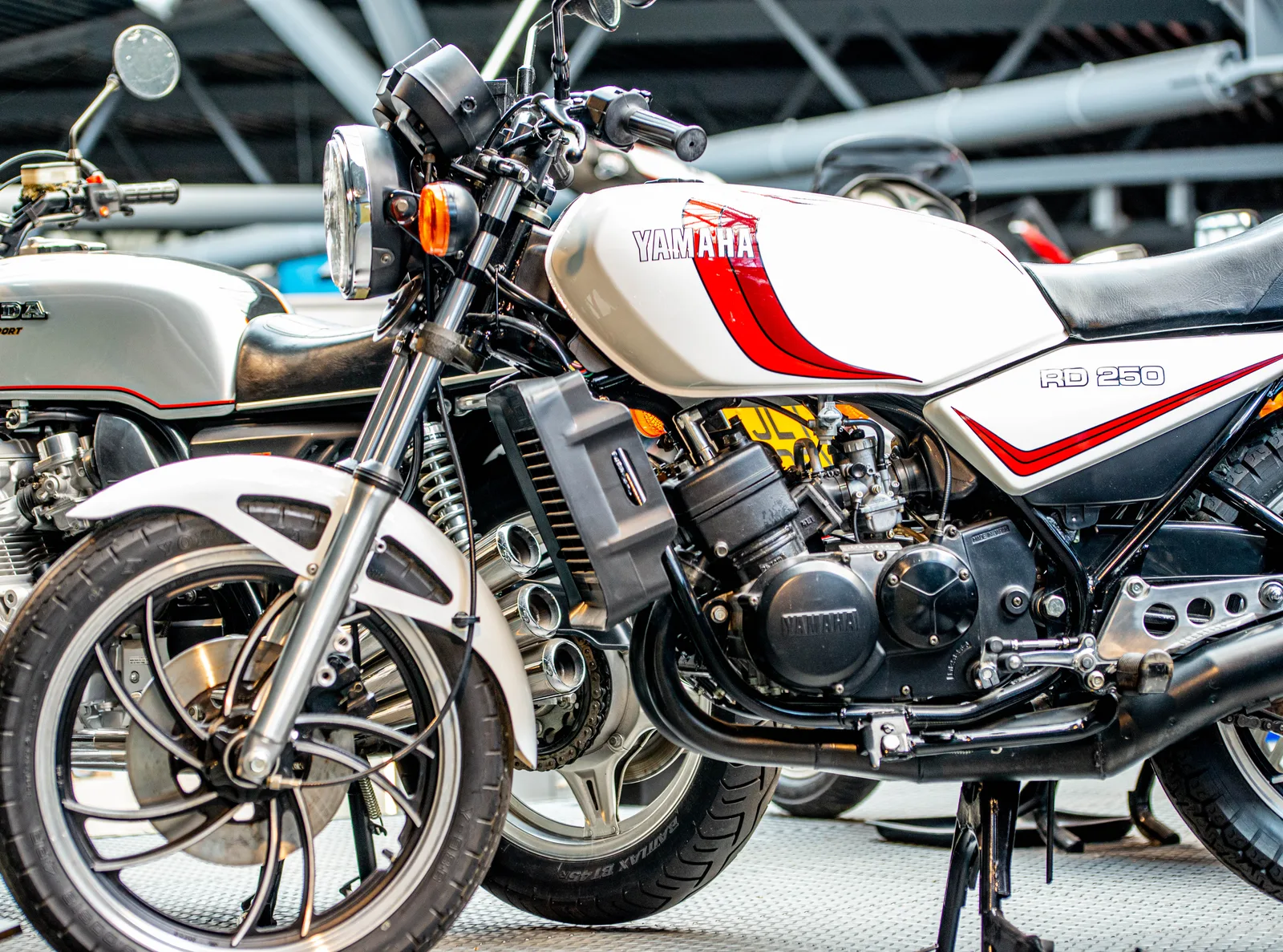
Featured image: Yamaha RD250LC — photo by www.mgaylard.co.uk, CC BY 2.0, via Wikimedia Commons.