
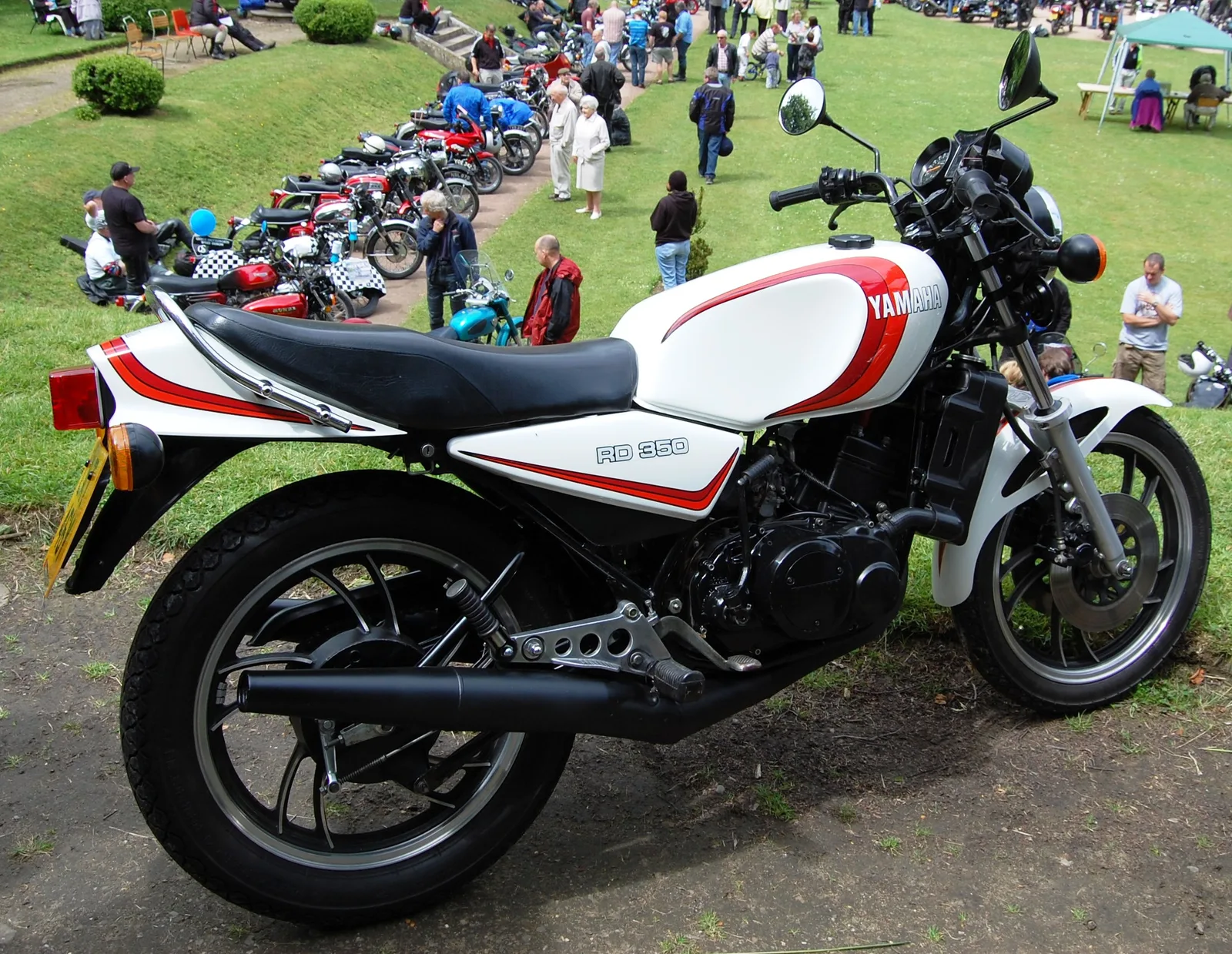
By Rahil "TorqueInductions" — my own RD350 is the air-cooled original, restored in my garage (the RX100 and Jawa 250 keep it company); the LC is the sequel I never owned but have ridden, wanted and written about for years. More about me →
Say "Elsie" in a British bike park and watch the over-fifties turn around. The nickname is just the initials pronounced — LC, Elsie — but it stuck to one motorcycle and no other, because no other motorcycle did what the RD350LC did to a generation of riders. This site has the LC woven through a dozen articles, and the bike has a tuning literature of its own. What it hasn't had here, until now, is its own story told straight.
The problem Elsie was built to solve
By 1978 Yamaha had a dilemma with two horns. The air-cooled RD250 and RD400 were due for replacement, and American emissions law was closing the door on performance two-strokes in the biggest market of all. The decision — pushed hard from within Yamaha Europe, where product planner Paul Butler argued the case — was to build the next RD for Europe instead: a pure sports two-stroke, developed with input from Yamaha's European engineering operation, using the technology of the TZ racers.
The TZ influence was real and specific. Yamaha's production racers had gone liquid-cooled years earlier (the TZ350A of 1973), and the monoshock rear end came from the same paddock. Both went into the LC, wrapped around an engine that, if we're honest — and period engineers were — owed more to the old air-cooled RD than to any TZ. Horizontally split crankcases, the same 64 × 54 mm dimensions, barrels that shared their architecture with what came before. The LC was a brilliant remix, not a clean sheet. That matters for the history of what the RD name means: the LC kept the faith while changing almost everything visible.
What arrived in June 1980
Production delays stoked the anticipation, and when the RD350LC reached British showrooms in June 1980 it still managed to exceed it. 347 cc, 47 bhp at 8,500 rpm, 143 kg dry, top speed around 110 mph. Twin discs at the front, a single disc's worth of braking ambition at the back, 18-inch cast wheels with those curved italic spokes, and the cantilever monoshock angled under the seat like the racers. MCN voted it Machine of the Year that November, and it wasn't close.
The engine had an endearing secret: it was designed as a 250. The 350 was created by fitting 64 mm pistons in place of the 250's 54 mm ones, which left the transfer ports cramped and the bike breathing through the same 26 mm carburettors as its little brother. Tuners like Stan Stephens built careers on the headroom that left. Some of that headroom is exactly what our RD350 YPVS tuning secrets digs into for the power-valve bikes that followed.
The riding experience explains the cult better than any figure. The engine drones, unremarkable, to about 5,000 rpm. Then the ports and pipes come into agreement and the bike lunges — period testers described an explosion, a helter-skelter, madness to 110 mph on skinny 32 mm forks. It wheelied. It wobbled at the edge. It was, by the standards of the sanitised machines around it, gloriously unserious. The RD250LC alongside it (35 bhp, a single front disc) was so close in spirit that the 350's small price premium nearly killed its sales.
