By Rahil "TorqueInductions" — I restore the big Yamaha two-strokes (RD350, RX100, Jawa 250) from my own garage; the RD50 is where the badge began for a generation of European riders, and it deserves its page. More about me →
Every family has a smallest member, and in the RD family it's very small indeed. The RD50 was 49 cc of single-cylinder two-stroke, and almost everything about it looks like a printing error until you remember the world it was built for: a Europe where, in country after country, the first rung of motorcycling was a 50, and the fight for teenage loyalty started there. Yamaha wanted those teenagers on an RD — any RD — years before the law would let them near a 250.
A motorcycle, not a moped with ideas
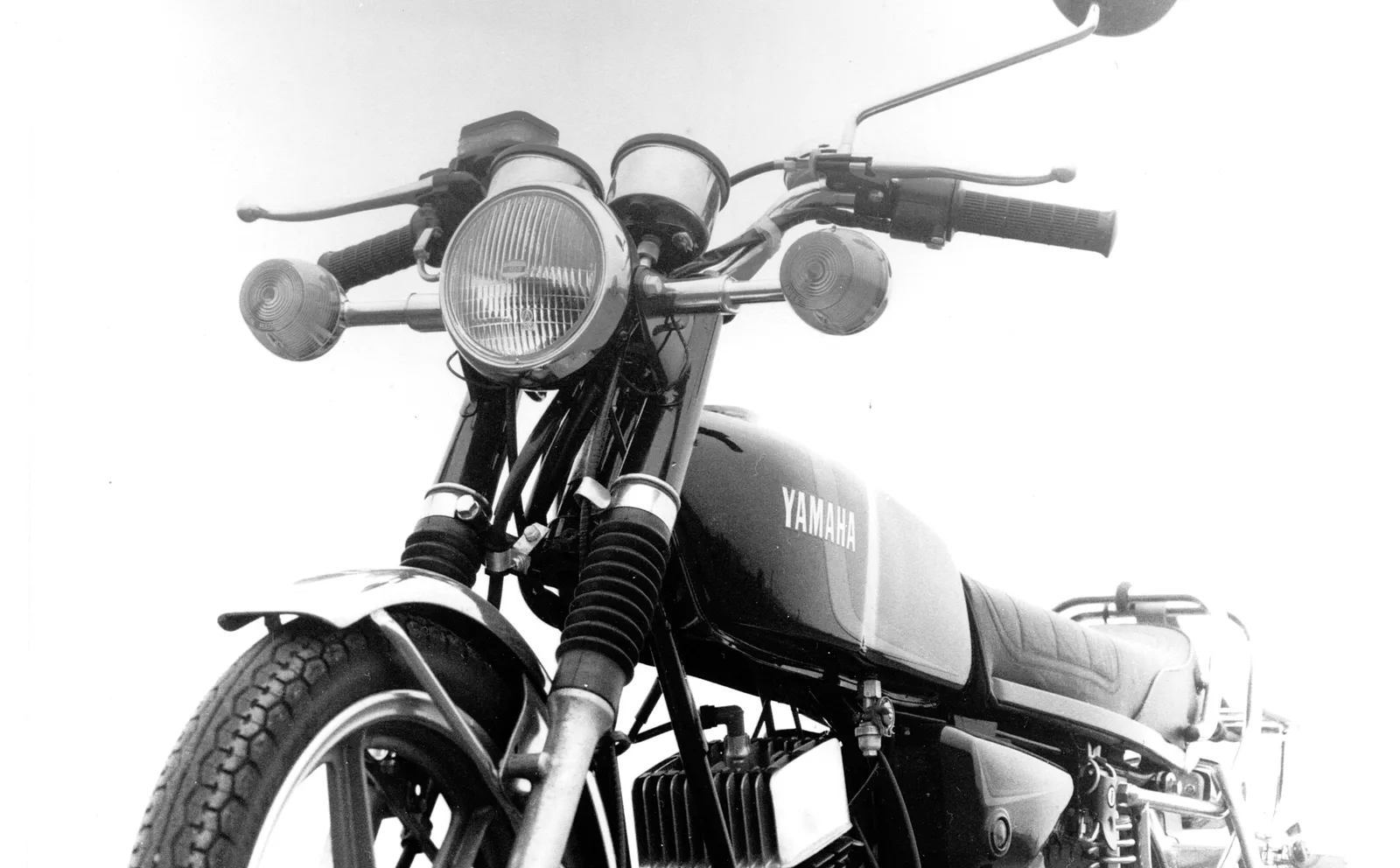
The distinction that mattered at sixteen was layout. Most 50s of the late seventies were step-throughs, shopping bikes with engines, designed to apologise for themselves. The RD50, launched in Japan in March 1978, was laid out like a motorcycle: tank in front of you, seat behind it, engine in the middle in a proper frame, 18-inch wheels, and a gearbox and clutch that worked like the real thing because they were the real thing, scaled down.
The engine is an air-cooled reed-valve single making 6.3 PS at 9,500 rpm in Japanese trim — call it a whisker over 6 horsepower pushing about 85 kg. In the unrestricted markets that was enough for genuine 70 km/h-plus pace, which for a sixteen-year-old in 1978 was effectively warp speed. A few months after launch came the RD50SP, with seven-spoke cast wheels and detail changes, because even at 49 cc the seventies believed in a sports model.
Britain's other sixteen-year-old Yamaha
In Britain the RD50M arrived into a market with one king: Yamaha's own FS1-E, the Fizzie, the sports moped against which everything else was measured. The RD50M was restricted to 30 mph as the law demanded, used the frame code 2E0, and sold alongside the Fizzie as the slightly more grown-up option — more motorcycle in design, less of a cult in practice. History gave the glory and the modern prices to the FS1-E. The RD50M got on with being ridden.
Germany took to it more seriously. The German moped and Mokick classes were huge, rule-bound worlds of their own, the RD50M fitted them perfectly, and the result is visible in today's classifieds: if you want an RD50 now, you're probably shopping in German listings, where tidy survivors surface regularly.

The derestriction years
Every restricted 50 lived two lives: the legal one and the one after a Saturday with a screwdriver. The RD50 was no exception — exhaust and intake restrictions came out, gearing changed, and a folk industry of go-faster knowledge passed between schoolyards. It's part of why honest, standard survivors are harder to find than modified ones, and why a completely original RD50M in Britain draws a crowd of men in their sixties at shows, each with a story involving a dual carriageway and optimism.
The bottom of the ladder
Put the range in a row — and the story of the RD name explains how that row came to exist — and the RD50 is the rung your boot touched first. It's easy to overlook in a golden era of two-strokes dominated by 500s and 750s, but the era ran on teenagers, and teenagers started here. It taught clutch control, premix-and-Autolube habits, the two-stroke's need to be revved and its talent for drama, in a package light enough to pick up when it fell over. Riders graduated: 50 to 125 to 250, badge intact. Manufacturers understood this arithmetic then. The RD50's entire existence is Yamaha doing the sum early and doing it properly, with a reed-valve single that revved to nine and a half thousand and a chassis that never talked down to its rider.
Finding one now means patience and probably a German postcode. Buy the standard bike over the tuned one, check the paperwork matches the 2E0 numbers, and expect the tinware — tank, side panels, the little stuff — to be the hardest parts of any restoration, because at sixteen nobody stored anything carefully. Some of us still don't.
Questions owners ask me
How fast is a Yamaha RD50?
Japanese-market bikes made 6.3 PS, good for over 70 km/h in unrestricted form. Export versions varied: British RD50Ms were restricted to 30 mph by law for sixteen-year-olds, and German versions followed their own moped-class rules.
What is the difference between the RD50 and RD50M?
The M is the moped-market version — restricted to suit local 50 cc rules, like Britain's 30 mph limit. Same basic 49 cc reed-valve single and motorcycle layout underneath.
RD50M or FS1-E — which was better?
The FS1-E won the culture war and holds the value; the RD50M was the more conventionally motorcycle-like machine. In period they sold side by side as Yamaha's two answers to the same sixteen-year-old question.
Where do I find an RD50 now?
Germany is the richest hunting ground — the RD50M was a staple of the German moped classes and survivors are commonest there. British RD50Ms surface occasionally; Japanese-market bikes are rare outside Japan.
Featured image: 1980 Yamaha RD50M — photo by Oxfordian Kissuth, CC BY-SA 3.0, via Wikimedia Commons.