By Rahil "TorqueInductions" — I restore Yamaha's two-strokes in my own garage (an air-cooled RD350, an RX100 and a Jawa 250); the RZs are the branch of the family tree that grew up on the other side of the world from my bikes. More about me →
Same motorcycle, two names, and a small lesson in how Yamaha saw the world in 1980. In Europe the new liquid-cooled twins were RDs, heirs to a dynasty. In Japan they were RZs — a fresher badge for a home market that didn't need the genealogy lesson. If you know the RD350LC story, you know most of this one. The differences are where it gets interesting.
The RZ250 comes first
The RZ250 was the debut act: revealed at the 1979 Tokyo Motor Show, on sale in 1980, and received at home like a dispatch from the future. Yamaha's own historical archive describes it without modesty — a pure sports model carrying TZ250 production-racer technology, 140 horsepower per litre (35 PS from 247 cc), Monocross suspension, cast wheels — and the company says plainly that the RZ250 and its sibling changed a market that had been drifting toward four-strokes. For once, the brochure undersold nothing. In our golden era of two-stroke motorcycles, the RZ250 is where the eighties really start.
Japan's licensing and insurance structure made the 250 the volume bike at home, the opposite of Europe, where the 350's small premium let it swallow the 250's sales. So the RZ250 wasn't the supporting act in its own country. It was the headline, it stayed in production in its original form until around 1986, and Japanese riders tuned, raced and crashed them in numbers Europe reserved for the 350.
The 750 Killer
The RZ350 arrived in 1981, the 347 cc engine in 45 PS Japanese-market trim, and acquired the nickname that follows it still: Nanahan Killer — the 750 Killer. "Nanahan" is Japanese slang for a 750, the era's superbike class, and the name records what happened on the touge, the mountain passes where Japan's riders settled arguments. A 45 PS two-stroke weighing around 143 kg, on tight switchbacks against heavy 750 fours making their power up high — the giant-killing was real enough that Yamaha's own archive uses the nickname today.
Europe's RD350LC claimed 47 bhp for ostensibly the same engine; Japan's 45 PS reflects home-market measurement and tune, a reminder that period power figures are arguments, not constants. The bikes under the badges were built to the same 4L0/4L1 architecture — the full Elsie story is told elsewhere in this batch of articles — with market details (lighting, gearing on some versions, colours and graphics) differing by destination. Australia, incidentally, sided with Japan: Australians bought RZ250s and RZ350s, which is why the RZ name has an Antipodean accent in the classic scene.

The R models, and the replica wars
Japan developed its RZs further and faster than Europe developed the RDs. In 1983 the RZ250R arrived with the YPVS power valve and a half-fairing, and the RZ350R followed the same recipe — sharper, faired, more serious, while Europe's range was consolidating around the RD350 YPVS. The RZ line's success is also the starting gun of Japan's racer-replica boom: Suzuki's RG250 Gamma, Honda's NS250 and the rest of the golden era's arms race all answer the RZ's demonstration that race technology, sold cheap, sells.
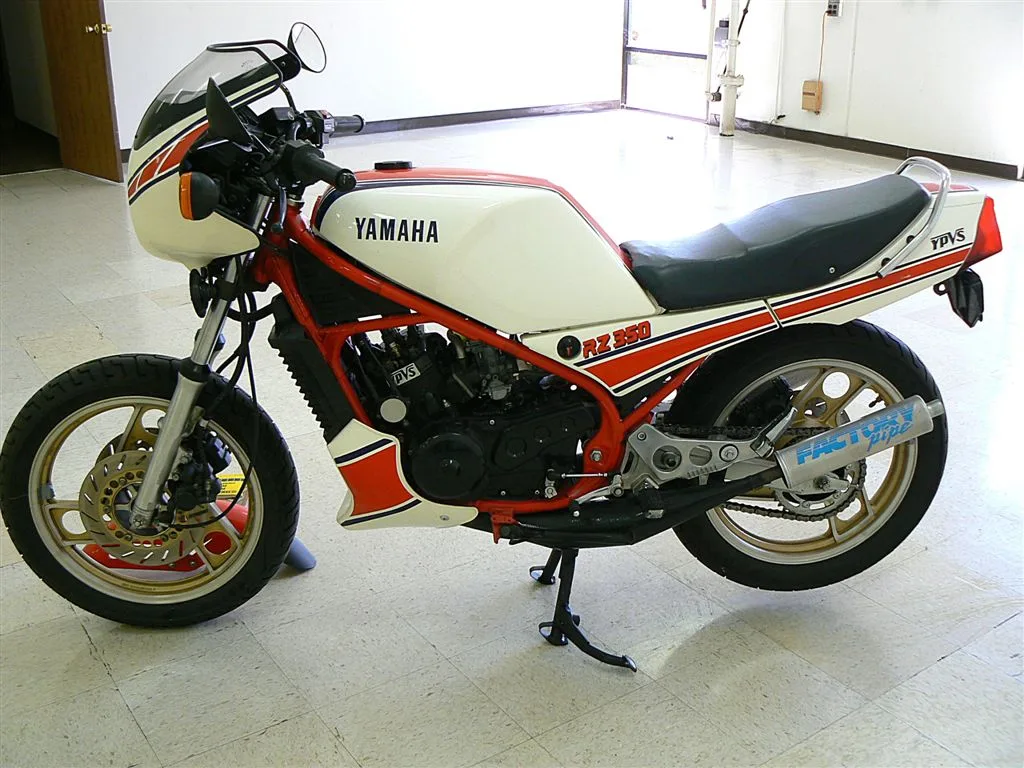
America is the footnote: it skipped the plain RZ/RD LC entirely on emissions grounds and only met the family in 1984, wearing RZ350 badges on the YPVS bike. So an American "RZ350" is always a Powervalve; a Japanese one might be the original Elsie-generation machine. That single fact confuses more cross-border parts orders than any other in the family, and it's why our YPVS tuning guide specifies generations so carefully.
The RZs now
Grey imports scattered RZs worldwide in the nineties, and Japan's own collectors have since woken up to what left. Clean home-market RZ350s are prized in Japan itself now, and the RZ250 — produced in real numbers, used as daily transport by a generation — is going the way of all working bikes: common once, cherished late. If you're buying, the naming is your first check: establish which generation and which market the bike was built for before you order a single part, because "RZ350" describes two meaningfully different motorcycles depending on which side of the Pacific stamped the frame.
Questions owners ask me
Are the RZ350 and RD350LC the same bike?
Essentially yes — the RZ350 is the Japanese (and Australian) market name for the machine Europe called the RD350LC, built to the same 4L0 architecture. Details like lighting, graphics and quoted power (45 PS in Japan, 47 bhp claimed in Europe) vary by market. The exception is America, where "RZ350" means the later YPVS model only.
Why is the RZ350 called the "750 Killer"?
"Nanahan" is Japanese slang for a 750 cc bike. The RZ350 earned the nickname — Nanahan Killer — by out-running and out-handling the big 750 fours of its day on Japan's mountain roads, where its light weight and sharp power delivery counted for more than top speed.
What is the difference between the RZ250 and RZ250R?
The RZ250 (1980) is the original liquid-cooled twin. The RZ250R (1983) added the YPVS exhaust power valve and a half-fairing, following the same upgrade path as the bigger bikes. The plain RZ250 continued alongside in production until about 1986.
Which is rarer today, RZ250 or RZ350?
The RZ350 attracts the money, but honest RZ250s are thinning out fast: they were Japan's everyday sports bike, ridden hard and used up. Survivors of either, in original home-market trim, are the ones to keep.
Featured image: Yamaha RZ350 (US-market model) — photo by Cnctrader, CC BY-SA 3.0, via Wikimedia Commons.