
Category: History

Yamaha RZV500R: Japan's Aluminium-Frame RD500

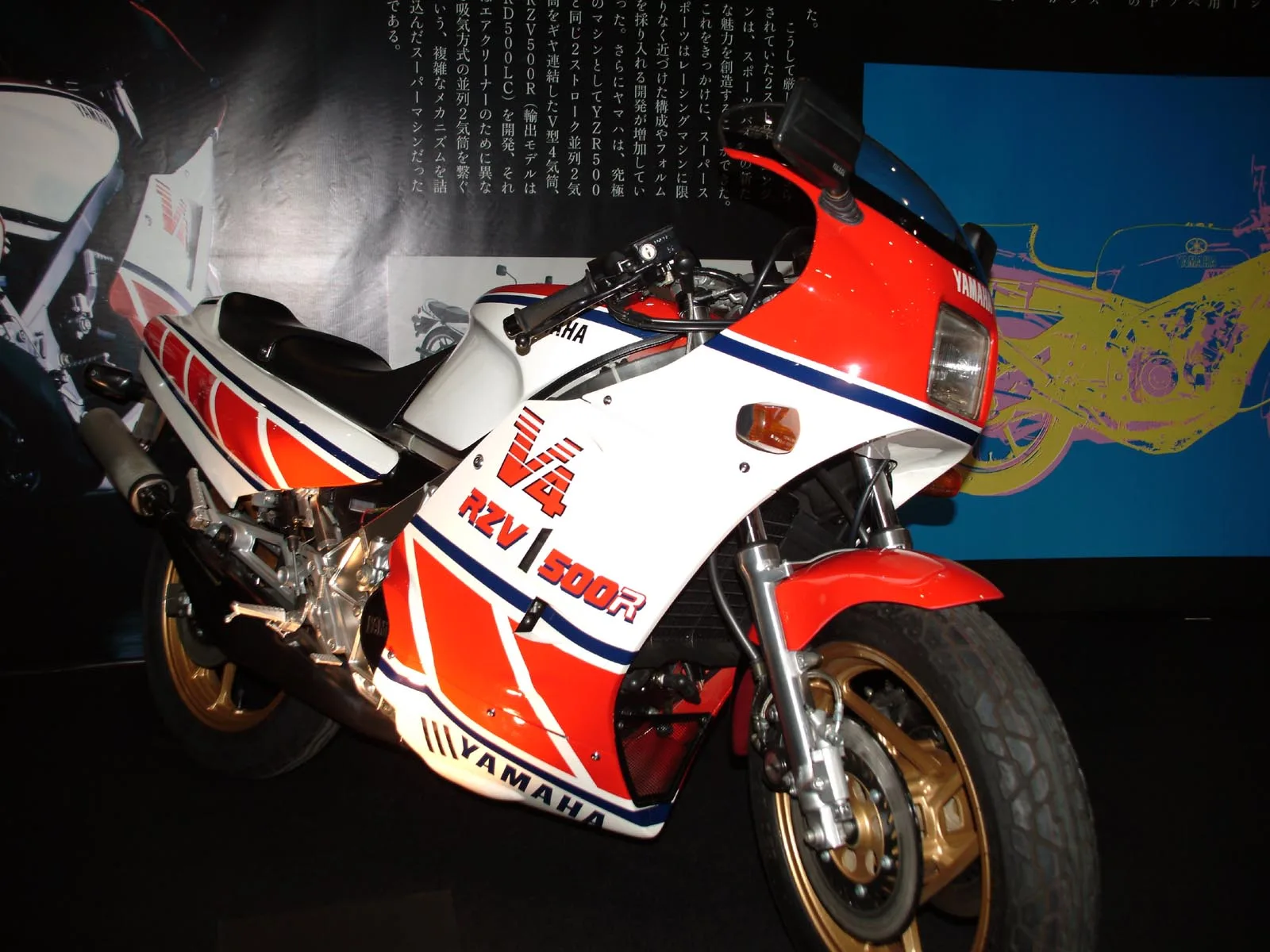
The Yamaha RZV500R is the Japanese home-market version of Yamaha's 499 cc V4 two-stroke flagship, sold elsewhere as the RD500LC in Europe and the RZ500 in Canada and Australia. Where those export bikes used a steel frame, the RZV500R was built around an aluminium frame, making it the lightest of the family. The trade-off was power: Japanese regulations capped the RZV500R at 64 PS, while export RD500LC models were rated at 88 PS. Everything else that defines the bike carried over — the liquid-cooled 50-degree V4 with two crankshafts, reed-valve induction, YPVS exhaust power valves, a six-speed gearbox and gear-driven primary drive. The RZV500R was built in the mid-1980s for Japan only and was never officially exported, which is why surviving examples are now sought after by collectors who want the rarest version of Yamaha's Grand Prix replica. It remains the answer to a good trivia question: the fastest-looking RD500 is, on paper, the slowest one Yamaha made.

Yamaha RZV500R: Japan's Aluminium-Frame RD500

By Rahil "TorqueInductions" — I restore and ride an RD350, an RX100 and a Jawa 250 in my own garage; the big V4 is a bike I know as an enthusiast rather than an owner, and I've written it that way. More about me →

Somewhere in Japan there is an RD500 with the wrong frame. Wrong if you know the export bikes, anyway. Lift the bodywork on an RZV500R and instead of the familiar steel cradle there's aluminium — because when Yamaha built the V4 for its home market in 1984, it built it a little differently from the ones it sent to Europe, Canada and Australia.

The RZV500R is best understood as a parallel-universe RD500LC. I wrote about the export bike in my piece on the Yamaha RD500LC V4 legend, and the mechanical recipe is shared: a 499 cc liquid-cooled two-stroke V4 with two crankshafts geared together, reed-valve induction, YPVS power valves in the exhausts, four carburettors and a six-speed gearbox. It was, and still is, the closest thing to a Grand Prix machine that Yamaha ever put a number plate on.

The frame is the headline

Export bikes — the RD500LC in Europe, the RZ500 in Canada and Australia — carried that engine in a steel frame. The RZV500R got an aluminium one. In the mid-eighties aluminium frames were exotic race-kitchen technology, not something you expected on a showroom machine, even a flagship. It made the Japanese bike the lightest of the family and, to most eyes now, the most desirable. It also makes it the connoisseur's version: same silhouette, same four-pipe soundtrack, but with a skeleton the rest of the world didn't get.

The catch: 64 PS

Japan's domestic rules are the other half of the story. Home-market bikes of the era were power-capped, and the RZV500R was rated at 64 PS where the export RD500LC claimed 88 PS. So the rarest, lightest RD500 is also, on paper, the least powerful — a fact that matters a great deal to collectors arguing over values and not at all once you're listening to a V4 two-stroke clear its throat. The restriction was achieved the way Japanese manufacturers usually did it, through the intake, exhaust and ignition side of the engine rather than any change to the basic architecture, which is why the bikes respond to export-spec parts. I'll leave the specifics there: anyone derestricting one today is working on a forty-year-old collector's item, and the work deserves a specialist, not a paragraph from me.

Yamaha RZV500R vs RD500LC — The Key Differences

Why it exists at all

Yamaha's home customers wanted the flagship too, and Japanese manufacturers of the period routinely gave the domestic market its own specification — sometimes lesser, sometimes, as with the frame, arguably better. The RZV500R also carried the small home-market touches you'd expect: instruments and details to Japanese spec, and a price that reflected the aluminium. It was never officially exported. Every RZV500R outside Japan today is a grey import that somebody wanted badly enough to ship.

That, in the end, is its position in the family. The RD500LC belongs to the golden era of two-strokes alongside the RG500 and NSR250 crowd. The RZV500R is the same motorcycle viewed through Japanese regulations: lighter, rarer, strangled. If the standard bike is the GP replica, the RZV is the GP replica as a limited edition — and the market has priced it that way ever since.

Questions owners ask me

Is the RZV500R faster than an RD500LC?

No. It's lighter thanks to the aluminium frame, but the 64 PS home-market limit against the export bike's 88 PS settles the argument. In the real world both are fast enough to be alarming; on paper the export bike wins.

Can an RZV500R be derestricted?

In principle, yes — the restriction lives in the intake, exhaust and ignition specification rather than in the engine's basic design, and export-spec parts exist. In practice it's collector-grade surgery on a rare bike, and most owners either leave it original or hand the job to a V4 specialist.

Why did Japan get an aluminium frame when Europe didn't?

Because the home-market flagship was expected to carry the newest technology for domestic bragging rights, and aluminium was it. Export models were built to a price for markets that, frankly, were getting the same headline power figure either way.

What should I check before buying one?

Provenance first — make sure it really is an RZV and not a dressed-up export bike, because the frame is the whole point. After that, the usual V4 checks apply twice over: cooling system health, power-valve operation, and any sign the engine has been apart. Aluminium of that age also deserves a close look around the welds and mounts.

Featured image: Yamaha RZV500R — photo by Rikita, CC BY-SA 3.0, via Wikimedia Commons.

Workshop resourcesBrowse manuals, downloads, and selected garage essentials. Support the archiveShare a correction, contribute knowledge, or get in touch.
Follow