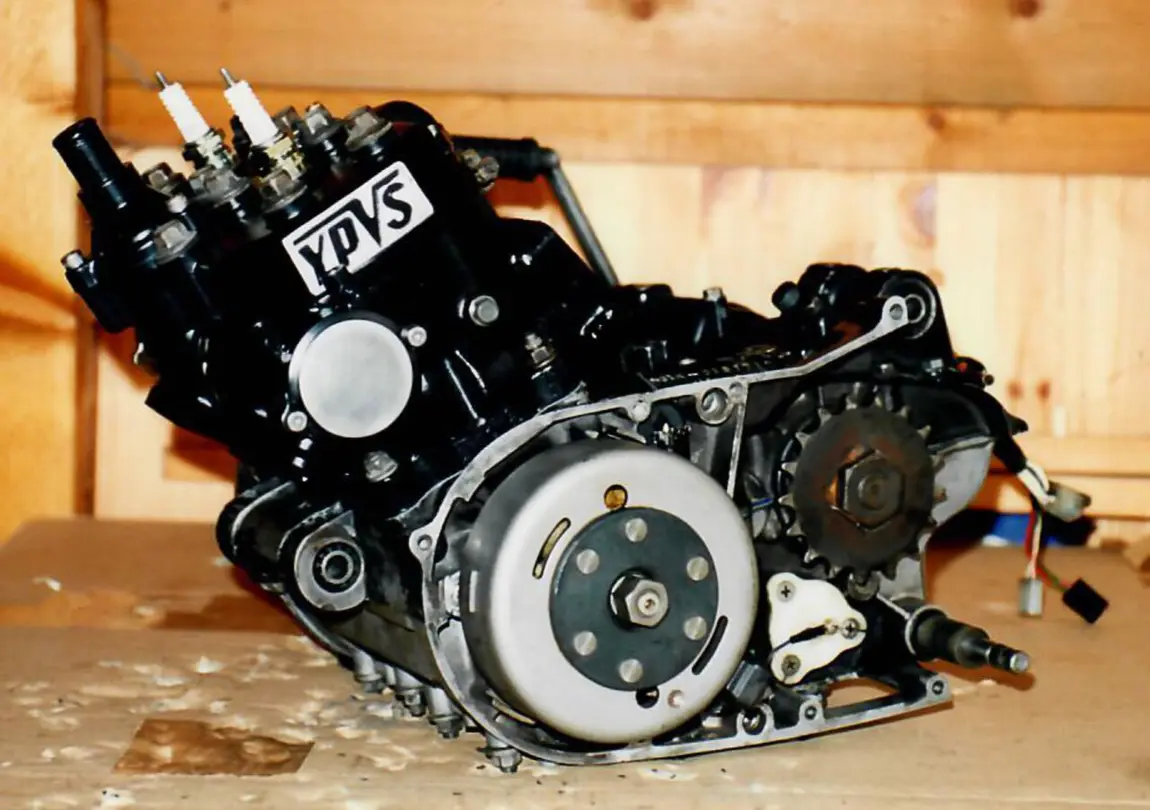
By Rahil "TorqueInductions" — Torque Induction isn't history to me: it's the reed blocks I pull, clean and check on my own RD350s and my RX100. Petals firs…
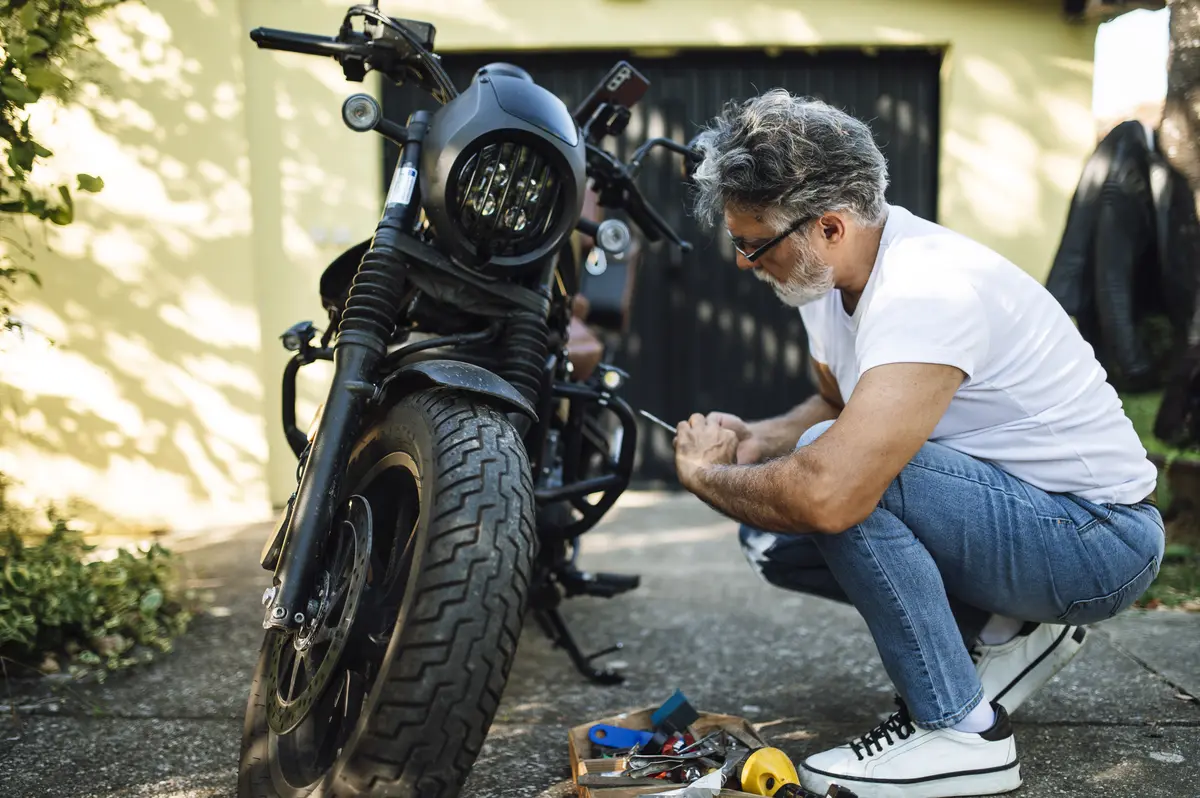
The motorcycle maintenance a beginner can safely do at home is a short list: read and replace the spark plugs (an NGK B8ES is gapped at 0.8 mm and goes in finger-tight plus a half to two-thirds of a turn), clean or replace the air filter, drain the carburettor float bowls and set the idle, clean, lube and adjust the chain (the Yamaha RD250/RD350 owner's manual specifies 20 mm of play and attention every 100 miles), lube the cables and set lever free play, clean the battery terminals and check fuses and earths, keep tyre pressures at the manual's figures, and inspect — not open — the brakes. The line to a mechanic sits at brake hydraulics, electrics beyond terminals and fuses, bearings, and anything involving the crankshaft. The saving on these jobs is real but it is the labour line on the bill, not a fixed amount anyone can honestly quote you.
A full Lambretta Li 150 Series 3 restoration starts with identity, not spanners: frame prefix 150LI3, a logbook that matches it, and metal honest enough to save. This walkthrough covers triage, the patch-or-replace call on the floor, a full engine rebuild back to factory jetting (Dell'Orto SH 1/18, main 105, pilot 45), the points-versus-electronic ignition decision, Lechler-coded paint, and what documented builds actually cost — from Scootering's £2,700 DIY Series 3 to a year-long, ₹1 lakh-plus Lamby revival in Kerala.
A two-stroke twin with two carburettors is two single-cylinder engines sharing a crankshaft, and twin-carb tuning is mostly synchronisation: both slides lifting together, both idle circuits set alike, both mixtures matched. There are four honest ways to sync a pair — watching the slides with a mirror, gauging them with a drill bit or feeler stock, balancing vacuum with gauges (which needs care on a pulsing two-stroke), and listening to the exhausts — and the right one depends on the bike and what stage the tune is at. Before any of them works, the carbs must be clean, the float heights equal, the cables free and the baseline set with both sides treated identically. Most twin-specific faults announce themselves as a difference between the two sides: one plug darker, one pipe hotter, one side smoking more — so you diagnose by comparison, swapping parts side to side to see whether the fault moves.
A vintage two-stroke's exhaust is different from a four-stroke's for a mechanical reason: its ports let part of each fresh fuel charge escape unburned (short-circuiting), and it burns its lubricating oil by design. The strongest measurements come from Platt et al. (Paul Scherrer Institute, Nature Communications, 2014), whose smog-chamber work on 50 cc two-stroke scooters found volatile organic compound emissions at idle averaging 124 times those of another vehicle class, benzene in raw idling exhaust as high as 300,000 micrograms per cubic metre, and aged aerosol formation 53–771 times laboratory values for other vehicle types — the finding behind their term "asymmetric pollution". The components of concern are established ones: PM2.5, whose links to heart disease, stroke, COPD and lung cancer the WHO treats as settled; benzene, an IARC Group 1 carcinogen that causes acute myeloid leukaemia; and PAHs, which Taiwanese dynamometer research found concentrated in the sub-2.5-micron particl
Restoring a Buell is harder than restoring most classics for one structural reason: the marque is an orphan. Harley-Davidson discontinued Buell on 15 October 2009 after building 136,923 motorcycles, and its promise to supply parts through dealers — quoted at the time as parts availability "for up to 10 years" — has long expired, so the owner community, donor bikes and a handful of specialists are now the supply chain. On top of that sit challenges no other marque combines: the XB's aluminium frame is its 3.7-gallon fuel tank and its swingarm carries the engine oil; the injected bikes run Buell's DDFI system, whose factory fuel-pressure test value is 49–51 psi, with diagnostics now handled by community software (ECMSpy, ECMDroid) rather than dealers; and the range covers three unrelated engine families — Sportster-based pushrod twins, the Blast's 492 cc Sportster-derived single (not a Rotax — the Rotax engine is the liquid-cooled 1,125 cc Helicon V-twin in the 1125R and 1125CR), each wi
"Ceramic coating" is two different products — high-temp exhaust ceramic (Cerakote, Jet-Hot) and detailing nano-ceramic for paint. Which belongs on a vintage bike's headers, original paint and chrome, what each really costs, and where neither is worth the money.
How to restore a classic motorcycle stage by stage — assess, paperwork, strip, frame, engine, carbs, electrics, paint — with the machining numbers measured, not guessed.
Rare vintage motorcycles worth restoring — the seven that pass the three-question test, with Hagerty guide values: Ducati 750 Sport, Kawasaki H2, Norton Commando, Honda CBX, Laverda Jota, BSA Rocket 3 and Moto Guzzi V7 Sport, plus the checks that separate a gem from a lawn ornament.
The Yamaha RD350 runs two 28 mm Mikuni VM28 carburetors, one per cylinder, and they are tuned as a matched pair: clean first, then set a stock baseline (140 main jet, 25 pilot jet, needle clip in the middle notch, idle 1,200–1,300 rpm), set the idle and air screws for the highest smooth idle with both screws kept even, work the needle for the mid-range, prove the main jet with a full-throttle plug chop, and finish by synchronising the slides so both cylinders pull together.
Jawa 250 Pérák parts, sourced honestly: the Czech catalogues that stock the type 11, where originals turn up, what the bike is worth, and how to spot fakes.
My 1974 Yamaha RD350 restoration started with a $2,000 barn find — faded purple paint, seized engine — and took six months and roughly 200 hours of weekends and late nights. The engine was split and rebuilt with new pistons, rings and seals in about 20 hours of the work; the twin Mikuni carbs needed an ultrasonic clean, a rebuild kit and a dozen jet cleanings; the wiring loom was rewired from scratch using a $120 reproduction harness. Parts came from eBay ($425, including rebuilt carbs for $200 and a tank for $150), forums ($300 NOS pistons, plus expansion chambers traded for a case of beer), swap meets ($100) and specialty shops ($210), and my total parts spend was about $1,500 on top of the $2,000 bike. I kept it stock — purple tank, original pipes — and it now sits in the $8,000–$12,000 range a clean restored RD350 commands.