The Yamaha RD250 (1973–79) is a 247 cc air-cooled two-stroke twin making 30 hp at 7,500 rpm and weighing 152 kg dry. It shared its chassis, brakes and twin Mikuni VM28 carburettors with the RD350, was the first production road bike with reed-valve "Torque Induction" induction, and was MIRA-tested at 93.8 mph in 1973. In Britain it was the fastest motorcycle a learner could legally ride until the 125 cc learner limit arrived in February 1983.
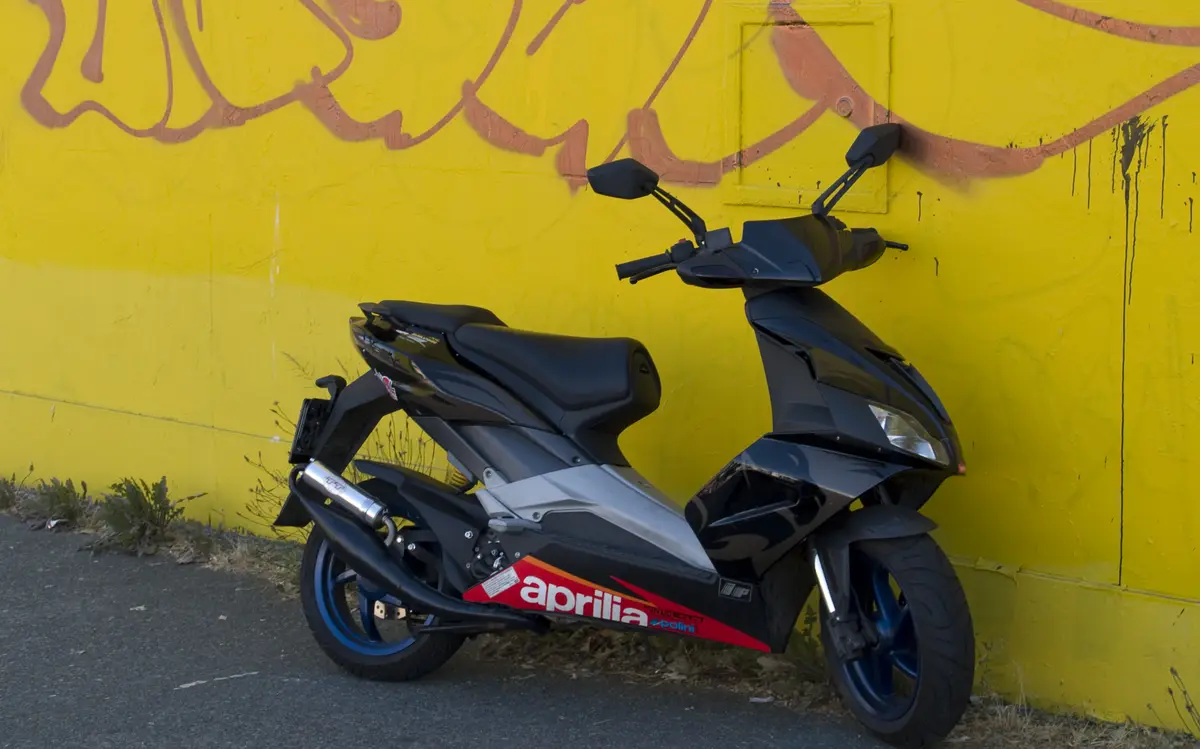
Aprilia DiTech (2000) was an air-assisted direct-injection two-stroke built under licence from Australia's Orbital and fitted to the SR 50 scooter. A crank-driven compressor supplied air at about 5 bar, fuel was metered into an air-fuel rail, and a direct injector fired the mixture into the cylinder after the exhaust port had closed — so fresh fuel could no longer short-circuit out of the exhaust. Aprilia claimed 40% lower fuel consumption, 60% lower oil consumption and 80% lower pollutant emissions than a carburetted 50, and the system met Euro 2. The production hardware was built by Synerject, the Orbital–Siemens joint venture. DiTech also powered the Scarabeo 50; Piaggio's PureJet and Peugeot's TSDI used the same licensed technology. It faded because the hardware was expensive for a 50 cc scooter, the compressor system collected condensation water, the Euro limits kept moving, and cheap fuel-injected four-strokes undercut it. Orbital's injection survived at sea in Mercury OptiMax ou
The Yamaha RX100 was a 98.2 cc air-cooled two-stroke single built in India by the Escorts Group with Yamaha, from November 1985 to March 1996. Based on Yamaha's RX-S and first assembled from Japanese CKD kits (full Indian production followed after 1990), it made 11 PS at 7,500 rpm and 10.39 Nm at 6,500 rpm, weighed 103 kg dry, and was good for about 100 km/h — figures that made it, by a wide margin, the fastest 100 cc motorcycle on sale in India, against commuter rivals like the 8.25 bhp Ind-Suzuki AX100. It cost roughly ₹19,000 at launch, was killed by tightening emission norms rather than falling demand, and was followed by the 132 cc RXG, RX-Z and RX135, none of which displaced it. Good original examples now change hands for ₹80,000 to ₹2 lakh.
From Audrey Hepburn's Vespa in Roman Holiday to Jimmy's Lambretta in Quadrophenia, the Armani and Dior Vespas, GTA's Faggio and Pixar's Luca — how scooters became pop culture's symbol of freedom.
The Rajdoot 350 was the Yamaha RD350B built under licence in India by the Escorts Group from 1983 to 1989. Detuned from the Japanese bike's 39 bhp to 30.5 bhp in the original High Torque (HT) version — and given a 180 mm twin-leading-shoe drum brake in place of the RD350B's front disc, to hold the price down — it was still by a huge margin the fastest motorcycle on sale in India, good for about 142 km/h, and it earned the "Widowmaker" name from an abrupt two-stroke powerband arriving on skinny 1980s tyres and drum brakes. A softer Low Torque (LT) version followed in 1985 at about 27 bhp. It launched at ₹18,000 ex-showroom in 1983; production ended in 1989 under the weight of its price, its thirst and its costly spares, and good survivors now change hands for several lakh rupees.
Most surviving Indian two-strokes — Rajdoot 350s, RX100s, Jawas — were never collected; they were handed down inside families, because in the eighties and nineties a motorcycle was often the most valuable machine a household owned and selling it was unthinkable. A documented example: Viraf Kapradewala bought a Yamaha RX100 new in 1988 and handed it to his son Kayos on his eighteenth birthday in 2022, after a restoration by YC Design (reported by BikeDekho). A hand-down is not complete with the keys: in India, when a registered owner dies, the legal heir must inform the RTO within 30 days and apply for transfer on Form 31 within three months, with the death certificate and proof of succession; an RC nominee can be named in advance since 2021. A handed-down bike stays on ordinary registration — 15 years, then five-year fitness renewals — because India's vintage category (MoRTH, July 2021) only starts at 50 years from first registration, which the earliest Rajdoot 350s reach in 2033. The
The story behind Hamara Bajaj: the Chetak's Vespa Sprint origins and ten-year waiting list, the 1989 ad that sold a queue as pride, and the Bollywood scooter scenes that actually check out — Bobby's included.
Scott Motorcycles of Bradford (later Saltaire/Shipley), Yorkshire, built the first production two-stroke motorcycles. Alfred Angas Scott (1875–1923), a marine-trained engineer who took out over 50 patents, patented a vertical-twin two-stroke engine in 1904 (GB 3367) and launched the first complete Scott in 1908: a 450 cc water-cooled twin with thermo-syphon cooling (no water pump), a patented triangulated frame, a two-speed chain transmission whose ratios were selected by clutches worked by a rocking foot pedal, and a patented kick starter. After Scott won the 1908 Wass Bank hill climb, the Auto-Cycle Union handicapped the bikes by multiplying their capacity by 1.32. A Scott was the first two-stroke to complete a full Isle of Man TT course (1910); Frank Phillip set the TT lap record at 50.11 mph in 1911; and Scotts won the Senior TT outright in 1912 (Frank Applebee) and 1913 (Tim Wood), with the fastest laps every year from 1911 to 1914, the TT racers using rotary valves from 1911. In
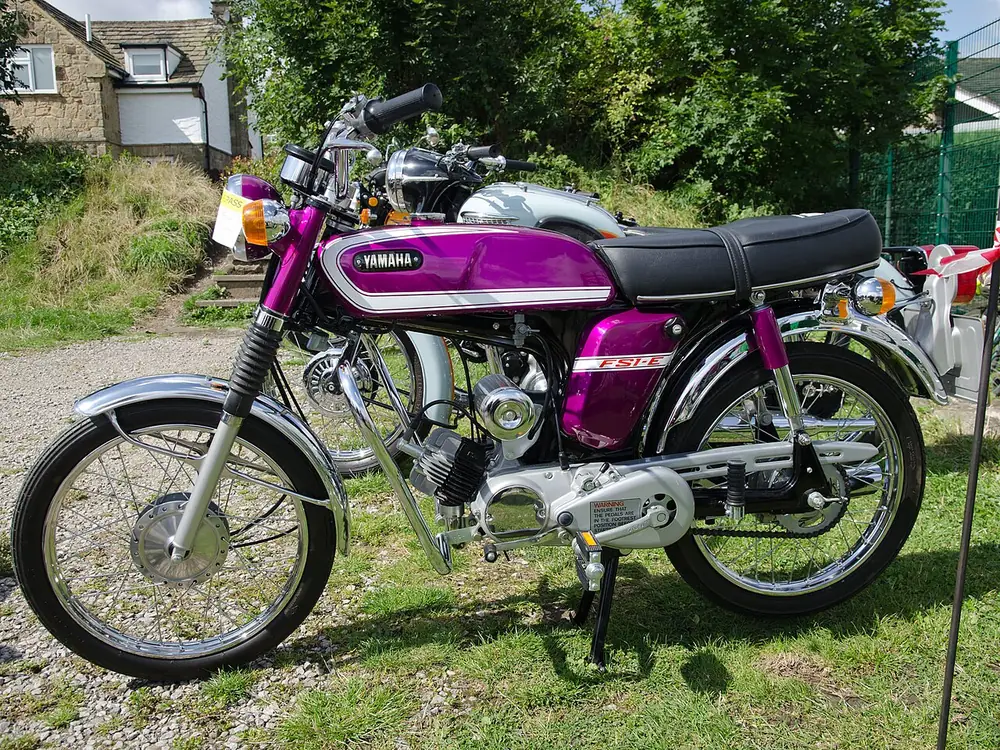
The Yamaha FS1-E — the "Fizzie" — is a 49 cc air-cooled two-stroke sports moped with a rotary disc-valve engine, a four-speed gearbox and bicycle pedals, built for the UK after the December 1971 "Sixteener Law" limited 16-year-olds to sub-50 cc mopeds. Yamaha quoted 4.8 bhp at 7,000 rpm and 45 mph for the unrestricted bike. It was launched in August 1972 badged SS ("Sixteener Special") and renamed FS1-E in January 1973, the E standing for England; the base FS1 was a Dutch-market five-speed motorcycle sold from 1969. Machines registered from 1 August 1977 were restricted to 30 mph and the classic era ended, though the model ran into the early 1980s and was revived in 1987. About 200,000 were produced for the UK market.
The golden era of two-stroke motorcycles runs roughly from 1971 to 1999, and five machines map it. The Kawasaki H2 Mach IV (1972–75) was a 748 cc air-cooled triple with a factory-claimed 74 bhp, a 12.0-second standing quarter for a standard bike and a Widowmaker reputation earned by its chassis. The Suzuki GT750 (1971–77) was the first Japanese motorcycle with a liquid-cooled engine — a 739 cc, 67 bhp touring triple called the Water Buffalo in America and the Kettle in Britain. The Suzuki RG250 Gamma (1983–87) brought chassis technology to the fore with the world's first mass-produced aluminium frame around a 247 cc, 45 PS twin. The Yamaha TZ750 (1974–79) was a pure racer — about 600 built, roughly 90 bhp rising to about 120 bhp, and nine consecutive Daytona 200 wins from 1974. The Honda NSR250R (1987–99) closed the era: a 249 cc V-twin race replica sold in four generations (MC16, MC18, MC21, MC28), restricted to 45 PS for Japan, with around 60 bhp available once derestricted. Emission
The Maico Mobil wrapped a fan-cooled two-stroke in a full car-style body. The real record — MB 151/175/200 specs, ~9,600 built, the 1957 England series, and why the bouncing starter belongs to the Maicoletta.
Cast-aluminium scooter, 124.7 cc two-stroke twin, three Bol d'Or class wins: the Rumi Formichino story, the Tipo Sport and Bol d'Or versions, specs and today's prices.