Motorcycle insurance is not optional anywhere you are likely to ride: India (Motor Vehicles Act s.146), the UK (Road Traffic Act 1988, plus continuous insurance enforcement) and every US state except New Hampshire require at least third-party liability cover. India's penalty for riding uninsured changed on 15 August 2026 — it is now three times the notified third-party base premium or ₹5,000, whichever is higher (repeat: five times or ₹10,000), replacing the old ₹2,000/₹4,000 fines and the jail term. Third-party cover is cheap because its premium is fixed by regulation (₹1,366 a year for a 150–350 cc motorcycle in India) and it protects everyone except you and your bike; comprehensive adds your own machine. The bike's value is irrelevant to the liability — the claim follows the injured person's losses, not what your motorcycle is worth.
A cutdown is a customised Vespa or Lambretta with bodywork removed or cut away, a style popular amongst skinheads and scooterboys during the mod revival of the 1970s and 1980s, with roots in the stripped "skelly" scooters of the late-1960s hard mods. The work divides by frame: a Lambretta's panels bolt onto a tubular steel spine and carry no structural load, so they can come off entirely, while a Vespa's pressed-steel monocoque is the structure, so Vespa panels are slimmed rather than deleted. Cutdowns were typically tuned as well as stripped, raced in a "specials" category (today's BSSO Group 5/6 Specials classes are the descendants), and branched into choppers — extreme cutdowns on extra-long forks — and rats built from old parts. Cutting is permanent: it removes a scooter from the originality market where recorded results for original SX200s reach £27,025, and in the UK a structural modification to a frame or monocoque must be notified to the DVLA.
The first disc brake fitted to a production two-wheeler was not on a superbike but on a scooter: the Lambretta TV175 Series 3 of 1962, with a cable-operated Campagnolo disc carried inboard in the front hub. The disc stayed on the TV200 and SX200, then left the range — the GP/DL models are drum-braked — and Vespa's PX only gained a standard front disc in 1998, with the PX 98. Modern conversions are complete engineered kits from named specialists: Casa Performance's hydraulic CasaDisc and Scooter the Fero's STF316 for Lambretta (both built around anti-dive units), Grimeca semi- and full-hydraulic kits for the Vespa PX pattern sold through SIP, and Qustom's reversible hydraulic actuator conversion that keeps the original hub. Fitting is specialist work done to the kit maker's instructions; some leading kits are sold, in their makers' own words, for sporting use only.
Real carbon panels for classic Vespas and Lambrettas exist — Italian prepreg at €149–€450 a part — but no maker publishes a weight for any of them. What carbon actually changes on a 105 kg scooter, what it costs, and where it must never go.
How expansion chambers work on Lambretta and Vespa scooters, the pipes that actually exist — JL, Franspeed, PM Tuning, SIP Road, clubmans — plus jetting, noise and the MOT, with the invented power claims removed.
There is no bolt-on kit — and no documented build, anywhere — for putting a transverse motorcycle twin (Moto Guzzi V50, Honda CX500 or any other) into a classic Vespa or Lambretta. The architecture forbids the easy version: on a classic scooter the engine is the rear suspension and driveline in one unit, and the Guzzi's longitudinal crank and shaft drive cannot be spliced to it with a welded clutch centre. The twin-cylinder scooters that genuinely exist are two-stroke conversions of the scooter's own engine: Scooter the Fero's Chimera kit (€4,460 plus €720–€1,160 of exhausts; about 450 cc and roughly 50 bhp with twin TS1 top ends; sold, in its maker's own words, for sporting use only) and Germany's Lutz twin (a patented one-piece twin crankshaft on standard casings; 106.4 PS on a nitrous dyno run; street versions around 60 bhp). In India, section 52 of the Motor Vehicles Act leaves no routine route to endorse a different engine in a vintage scooter; in the UK an engine change needs DVL
How the mods turned Vespas and Lambrettas into the sharpest scooters ever built — the mirrors, the chrome, the skelly cutdowns, the 1979 revival and the scooterboy split, checked against the record.
Why classic Vespas and Lambrettas still stop traffic — D'Ascanio's 1946 grammar, the slimstyle, Bertone's GP, the colours and materials that age well, and five cheap touches that fake fifty years.
From Audrey Hepburn's Vespa in Roman Holiday to Jimmy's Lambretta in Quadrophenia, the Armani and Dior Vespas, GTA's Faggio and Pixar's Luca — how scooters became pop culture's symbol of freedom.
Which RD350 clubs in India can you actually verify? The Bangalore RD350 Club, Kerala’s God’s Own Lords, RDDreams, Chennai’s documented groups — plus how to find and judge a local owners’ group.
The Rajdoot 350 was the Yamaha RD350B built under licence in India by the Escorts Group from 1983 to 1989. Detuned from the Japanese bike's 39 bhp to 30.5 bhp in the original High Torque (HT) version — and given a 180 mm twin-leading-shoe drum brake in place of the RD350B's front disc, to hold the price down — it was still by a huge margin the fastest motorcycle on sale in India, good for about 142 km/h, and it earned the "Widowmaker" name from an abrupt two-stroke powerband arriving on skinny 1980s tyres and drum brakes. A softer Low Torque (LT) version followed in 1985 at about 27 bhp. It launched at ₹18,000 ex-showroom in 1983; production ended in 1989 under the weight of its price, its thirst and its costly spares, and good survivors now change hands for several lakh rupees.
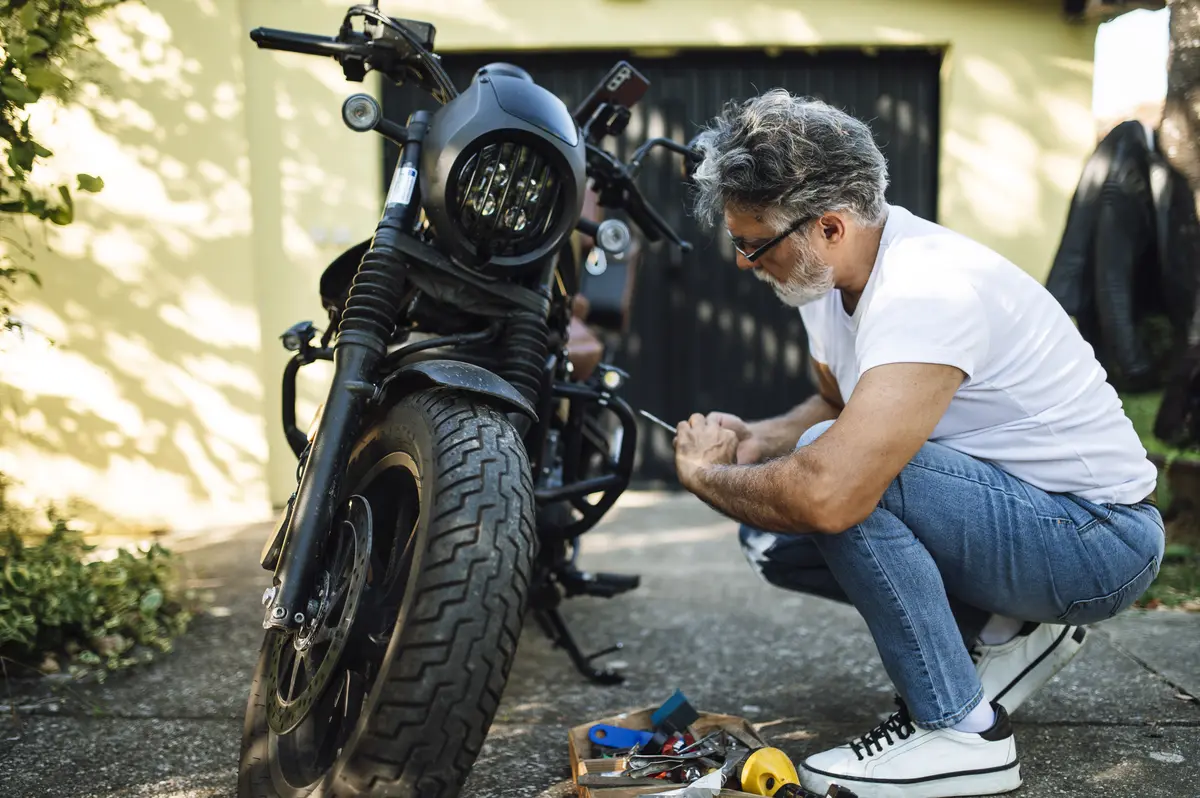
The motorcycle maintenance a beginner can safely do at home is a short list: read and replace the spark plugs (an NGK B8ES is gapped at 0.8 mm and goes in finger-tight plus a half to two-thirds of a turn), clean or replace the air filter, drain the carburettor float bowls and set the idle, clean, lube and adjust the chain (the Yamaha RD250/RD350 owner's manual specifies 20 mm of play and attention every 100 miles), lube the cables and set lever free play, clean the battery terminals and check fuses and earths, keep tyre pressures at the manual's figures, and inspect — not open — the brakes. The line to a mechanic sits at brake hydraulics, electrics beyond terminals and fuses, bearings, and anything involving the crankshaft. The saving on these jobs is real but it is the labour line on the bill, not a fixed amount anyone can honestly quote you.