Where rare vintage scooter parts actually turn up — the marque catalogues, the NOS shelves, the clubs and the jumbles — how the factory part number protects you, and how to spot a fake before it costs you.
Pre-mix and oil injection differ by one idea: a ratio versus a metering pump. Pre-mix at 40:1 — the ratio Yamaha's own manuals suggest when an RD-era twin is converted for competition — puts 25 ml of oil into every litre of petrol; at an example oil price of ₹800 a litre that is ₹20 of oil burned per litre of fuel. Yamaha's Autolube pump has no fixed ratio: driven from the crankshaft so it strokes with rpm, with its stroke length set by a throttle cable, it feeds about ten times more oil at full throttle than closed — roughly 20:1 at full tilt, a dribble at idle — so its average over a tank is whatever your right hand makes it. Work the example at a 60:1 average and injection burns about 17 ml, ₹13, per litre; over 30 litres a month that is ₹400 against pre-mix's ₹600, a gap of about ₹2,400 a year at the example price. The gap reverses at sustained full throttle, where the pump out-feeds 40:1 pre-mix, and it is dwarfed either way by the failure costs: a forgotten premix measure or a si
Most surviving Indian two-strokes — Rajdoot 350s, RX100s, Jawas — were never collected; they were handed down inside families, because in the eighties and nineties a motorcycle was often the most valuable machine a household owned and selling it was unthinkable. A documented example: Viraf Kapradewala bought a Yamaha RX100 new in 1988 and handed it to his son Kayos on his eighteenth birthday in 2022, after a restoration by YC Design (reported by BikeDekho). A hand-down is not complete with the keys: in India, when a registered owner dies, the legal heir must inform the RTO within 30 days and apply for transfer on Form 31 within three months, with the death certificate and proof of succession; an RC nominee can be named in advance since 2021. A handed-down bike stays on ordinary registration — 15 years, then five-year fitness renewals — because India's vintage category (MoRTH, July 2021) only starts at 50 years from first registration, which the earliest Rajdoot 350s reach in 2033. The
Two-strokes are not banned — new sales were. What BS6 (2020), Euro 5, London's ULEZ, Germany's H-plate, Delhi's 15-year rule and India's 50-year vintage category actually say about your classic, as of 2026.
The YZ490/IT490 detonation fix is cylinder-head machining: the sharp edge where the wide squish band meets the combustion-chamber dome is radiused and the dome reshaped, then chamber volume and squish clearance are re-set by measurement. Period tests and the tuners who fixed these bikes for a living (Al Holley; Broc Glover's mechanic Jon Rosenthal) document it, and PulpMX's model history is blunt that the head had to be modified — swapping jets never cured a 490. Yamaha's own tuning manual asks for premium fuel of at least 90 octane and gives the plug evidence of detonation damage: aluminium speckles on the insulator, from a melting piston crown.
A two-stroke café racer build, centred on the Yamaha RD350, in eleven stages: choose a sound, titled donor and get it running in completely stock form before modifying anything; strip and inspect the frame, cutting only the tail behind the rear shock mounts (never the steering head, engine cradle or swingarm pivot); fit clip-ons and rear-sets as a matched ergonomic pair; treat every ride-height change as a steering-geometry change, because raising or lowering either end alters trail; service the engine rather than tuning it, and keep the expansion chambers — they are a two-stroke's real tuning; keep the stock airbox or budget a full rejet, because pod filters upset every carburettor circuit and a lean midrange can seize a two-stroke; service the brakes your market's bike actually has (the export RD350 of 1973–75 has a 267 mm front disc as standard, the Indian Rajdoot has drums at both ends); be careful with lithium batteries on loosely regulated vintage charging systems; and paint only
A stock air-cooled Yamaha RD350 (1973–75) made 39 hp at the crank (about 32 hp at the rear wheel) and was quoted at 105 mph, but period magazine instruments measured two-way top speeds of 102.6–103.8 mph, quarter miles between 14.12 seconds (Cycle magazine, the best) and 14.75 seconds, and 0–60 mph in about 5.2 seconds — not the 130 mph and 4.8 seconds of bar talk. The RD350LC made 47 hp (factory) and averaged 107.1 mph two-way at MIRA with a 13.82-second quarter; the YPVS made 59 hp (factory) and its US RZ350 version ran 13.19 seconds in period testing; India's Rajdoot 350 HT made 30.5 bhp (factory) and was commonly cited at under 7 seconds to 100 km/h in period Indian tests.
The story behind Hamara Bajaj: the Chetak's Vespa Sprint origins and ten-year waiting list, the 1989 ad that sold a queue as pride, and the Bollywood scooter scenes that actually check out — Bobby's included.
Scott Motorcycles of Bradford (later Saltaire/Shipley), Yorkshire, built the first production two-stroke motorcycles. Alfred Angas Scott (1875–1923), a marine-trained engineer who took out over 50 patents, patented a vertical-twin two-stroke engine in 1904 (GB 3367) and launched the first complete Scott in 1908: a 450 cc water-cooled twin with thermo-syphon cooling (no water pump), a patented triangulated frame, a two-speed chain transmission whose ratios were selected by clutches worked by a rocking foot pedal, and a patented kick starter. After Scott won the 1908 Wass Bank hill climb, the Auto-Cycle Union handicapped the bikes by multiplying their capacity by 1.32. A Scott was the first two-stroke to complete a full Isle of Man TT course (1910); Frank Phillip set the TT lap record at 50.11 mph in 1911; and Scotts won the Senior TT outright in 1912 (Frank Applebee) and 1913 (Tim Wood), with the fastest laps every year from 1911 to 1914, the TT racers using rotary valves from 1911. In
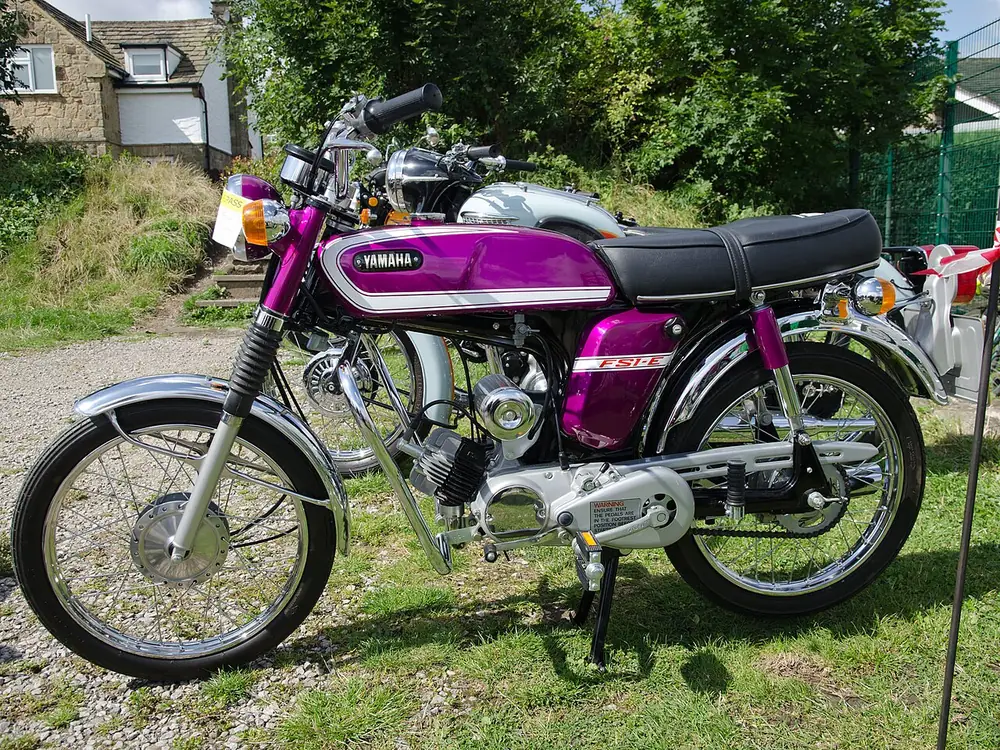
The Yamaha FS1-E — the "Fizzie" — is a 49 cc air-cooled two-stroke sports moped with a rotary disc-valve engine, a four-speed gearbox and bicycle pedals, built for the UK after the December 1971 "Sixteener Law" limited 16-year-olds to sub-50 cc mopeds. Yamaha quoted 4.8 bhp at 7,000 rpm and 45 mph for the unrestricted bike. It was launched in August 1972 badged SS ("Sixteener Special") and renamed FS1-E in January 1973, the E standing for England; the base FS1 was a Dutch-market five-speed motorcycle sold from 1969. Machines registered from 1 August 1977 were restricted to 30 mph and the classic era ended, though the model ran into the early 1980s and was revived in 1987. About 200,000 were produced for the UK market.
The golden era of two-stroke motorcycles runs roughly from 1971 to 1999, and five machines map it. The Kawasaki H2 Mach IV (1972–75) was a 748 cc air-cooled triple with a factory-claimed 74 bhp, a 12.0-second standing quarter for a standard bike and a Widowmaker reputation earned by its chassis. The Suzuki GT750 (1971–77) was the first Japanese motorcycle with a liquid-cooled engine — a 739 cc, 67 bhp touring triple called the Water Buffalo in America and the Kettle in Britain. The Suzuki RG250 Gamma (1983–87) brought chassis technology to the fore with the world's first mass-produced aluminium frame around a 247 cc, 45 PS twin. The Yamaha TZ750 (1974–79) was a pure racer — about 600 built, roughly 90 bhp rising to about 120 bhp, and nine consecutive Daytona 200 wins from 1974. The Honda NSR250R (1987–99) closed the era: a 249 cc V-twin race replica sold in four generations (MC16, MC18, MC21, MC28), restricted to 45 PS for Japan, with around 60 bhp available once derestricted. Emission
The Maico Mobil wrapped a fan-cooled two-stroke in a full car-style body. The real record — MB 151/175/200 specs, ~9,600 built, the 1957 England series, and why the bouncing starter belongs to the Maicoletta.